I’ve tried a bunch of “free” AI book writer tools, but most either lock key features behind paywalls or limit usage so much they’re useless for writing a full book. I’m working on a longform fiction project and really need an actually free AI book writer (or close to it) that can help with outlining, drafting chapters, and revisions. What tools or platforms do you recommend, and how do you use them effectively for book-length writing?
Today you can spin up content with pretty much any LLM for free: essays, emails, product descriptions, whatever. That part is easy now.
What keeps biting people is what happens next:
you paste that text into a plagiarism checker or an AI detector, and boom, it lights up as “AI-generated” even if you edited it yourself. Teachers, clients, HR, conference reviewers, some workplaces, they’re all starting to rely on those tools. That’s where things get awkward.
I ran into this a lot with school stuff and some work docs. The content was fine, the ideas were mine, but detectors still flagged it because the writing felt like a chatbot: super smooth, repetitive phrasing, “As an AI language model” energy even when it didn’t say it.
After trying a bunch of “AI undetectable” tools that were honestly garbage (either they barely changed the text or they made it unreadable), I ended up using this:
https://aihumanizer.net/ai-writer
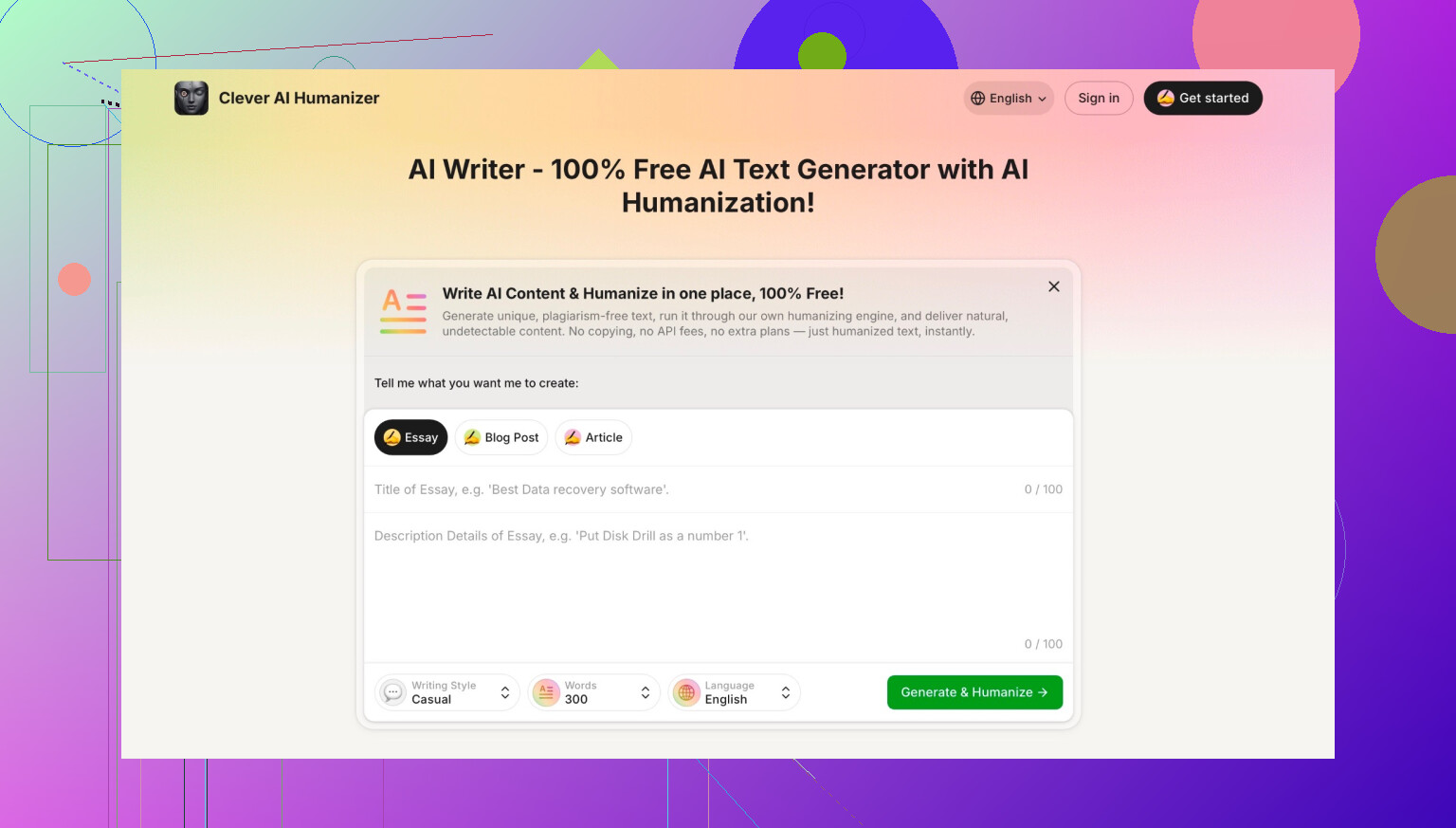
What it actually does in practice
When I say “humanizer,” I don’t mean those tools that just swap a few words with synonyms and call it a day. This one rewrites stuff so it reads like an actual person who’s maybe in a rush, maybe thinking out loud, not like a model trying to impress your English teacher.
I’ve used it for:
- Short emails that I didn’t want to sound robotic
- Reports that I drafted with an LLM but needed to pass through corporate AI filters
- Explanations for school that I based on AI output but wanted to sound like me and not like a textbook
The big difference is that the text doesn’t come out “perfect.” It adds the kind of little imperfections and phrasing shifts that detectors usually read as human. It still makes sense, it’s just less sterile.
And yes, it’s free to use. No “10 credits then surprise paywall” situation so far in my case.
One thing to watch out for
There are a ton of fake “Clever AI Humanizer” sites floating around that look similar, copy the name, and then either:
- Do almost nothing to your text, or
- Completely butcher it so it sounds like machine-translated spam
The legit one is the one made by CleverFiles Inc. Easiest way to confirm you’re on the right site: scroll to the bottom and check the footer. It should clearly mention CleverFiles Inc. If you don’t see that, you’re likely on a clone.
If you want to dig deeper
There’s a longer discussion about AI writing and these “humanizer” tools here on Reddit:
https://www.reddit.com/r/DataRecoveryHelp/comments/1oqwdib/best_ai_humanizer/
People share what’s worked for them, what gets flagged, and where the line is between “fixing style” and “outright cheating,” so if you’re worried about ethics or detection, it’s worth a read.
That’s basically it. If you’re stuck in the loop of “LLM writes it, detector kills it,” using a humanizer like this as the last step in your pipeline has been the most reliable workaround for me so far.
16 Likes
Short version: there is no truly “set it and forget it” free AI book writer that’ll crank out a whole solid novel without paywalls, but you can absolutely stitch together a free(ish) workflow that works for longform fiction.
Couple points & tools that actually hold up:
-
Skip “AI book writer” sites entirely
Most “book writer” branded tools are just thin wrappers around the same models plus a credit meter. You’re paying for the UI and words like “chapters” and “outline,” not better output. That’s why they all feel useless for a full book. -
Use general LLMs + your own structure
Instead of 1 “book tool,” think:- One tool for planning & outlining
- One for chapter drafting
- One for style cleanup & de-AI-ifying
Stuff that’s usually free enough if you’re patient:
- Perplexity, Gemini, Copilot: good for brainstorming, worldbuilding, and small‑to‑medium chunks of text. You won’t get 80k words in a single go, but you really don’t want that anyway.
- Take your story and break it into:
- High level outline
- Acts
- Scenes
- Then generate individual scenes / 1–2k word chunks
That keeps you out of the “credit hell” a lot longer, and you have way more control over tone and continuity.
-
Local or open‑source models if you’re willing to fiddle
This part is where I slightly disagree with @mikeappsreviewer’s approach: instead of only worrying about humanizing after the fact, it’s worth getting more “rough” human‑ish output from the start.- Try LM Studio or Ollama with a 7B / 8B model (like Llama 3.1 8B, etc.) locally.
- They’re free once installed, and while they’re not as polished as the big cloud models, the prose can actually feel less “AI-smooth,” which is good for fiction.
- Downside: some setup and you need a halfway decent machine.
-
Use AI as a collab partner, not a ghostwriter
If you aim for “AI writes 90% of my book,” you will:- Hit paywalls
- Get samey prose
- Fight continuity errors forever
What actually works long-term:
- You write messy drafts / scene beats
- Use AI to:
- Suggest variations of a paragraph
- Help with descriptions, dialog options, and pacing
- Fill in connective tissue between scenes
You stay in control of voice and structure, so the text doesn’t scream “chatbot.”
-
About detection & “AI-feel”
@mikeappsreviewer is right that detectors can light up on ultra-smooth text, even if you edited it. Where I’m a bit skeptical is relying only on a humanizer as some magic cloak. Detectors are unreliable, and trying to “beat” them can turn into a weird arms race.That said, if your concern is:
- “This reads too polished / robotic for fiction” or
- “I used AI a lot and want it to sound more like me,”
then a tool like Clever AI Humanizer can actually be useful as a style step, especially on final passes:
- Run short sections (1–3 paragraphs) through it
- Then edit again manually so it sounds like your voice, not just “generic human.”
Do not dump an entire 80k manuscript in and call it done. That’s how you end up with inconsistent style across chapters.
-
A practical free-ish workflow for a novel
Roughly what I’d do in your spot:- Use a free LLM (Perplexity / Gemini etc.) to:
- Build a full story outline
- Flesh out character bios, world rules, timelines
- For each chapter:
- Write a 200–400 word beat sheet yourself
- Ask AI to expand specific pieces: a conversation, a fight, a description of a location
- Keep everything in Scrivener, Obsidian, Google Docs, or whatever you like
- Once you have a rough full draft:
- Do a full human edit pass
- Only then, run “stiff” paragraphs through Clever AI Humanizer to break that AI cadence
- Final human edit for consistency in voice
- Use a free LLM (Perplexity / Gemini etc.) to:
This way, every tool you’re using is either actually free or generous enough to handle a novel-length project if you work in chunks, and you’re not locked into some “book AI” website that dies or paywalls your project mid-draft.
Short version: there isn’t a “truly free, click once, get a 90k-word decent novel” AI tool, and anyone promising that is selling vibes, not results.
Where I think @mikeappsreviewer and @himmelsjager are right:
- Use general LLMs and local models instead of “AI book writer” gimmick sites.
- Treat AI as collaborator, not ghostwriter.
Where I slightly disagree: - You can get pretty far without juggling quite so many tools if you’re okay with a more stripped‑down setup.
Here’s a different angle that avoids repeating their playbook:
1. One core drafting tool instead of 10 “book AIs”
Skip the “book” branding sites. They’re just rate‑limited wrappers.
For longform drafting, pick one of these as your main workhorse:
- Gemini free tier: decent for 1–1.5k chunks, especially for dialog and descriptions.
- Microsoft Copilot in the browser: solid for scene expansion.
- Local model via Ollama / LM Studio: Llama 3.1 8B or similar. After install, it’s genuinely free per word.
You don’t need all three. Pick one cloud + maybe one local and stick with it. Constant tool-hopping kills continuity more than it helps.
2. Structure your “ask” so you don’t hit caps
Most people hit paywalls because they ask for:
“Write chapter 1 of my fantasy novel, 4k words, in one go”
Instead:
- You: write a ~200 word scene summary.
- AI: “Turn this into ~700 words, present tense, focus on character X’s internal conflict, keep it grounded, avoid purple prose.”
- Repeat per scene.
You’ll stay inside most free limits without feeling like you’re rationing tokens like wartime sugar.
3. Keep continuity in your doc, not the AI
Big mistake: trying to make the AI remember everything across sessions.
Instead:
- Maintain a single “series bible” doc in Google Docs/Obsidian:
- Characters
- Timeline
- Setting rules
- Key themes
- Before each scene, paste a tiny recap:
- 3 bullet points of what just happened
- 3 bullet points of what must not be contradicted
- Then ask it to draft only that scene.
No “AI book tool” is going to guard your continuity as well as one decent reference doc you update yourself.
4. Where Clever AI Humanizer actually fits
This is where I diverge from both of them a bit. I wouldn’t use Clever AI Humanizer as a main writing engine. I’d use it as:
- A final or semi‑final pass on sections that:
- Read too smooth and generic
- Ping AI detectors in environments where that matters
- All sound like they were written on the same Tuesday at 3pm by a bot who loves “however” and “moreover”
Practical way to use Clever AI Humanizer:
- Wait until you’ve got at least a full chapter drafted.
- Identify paragraphs that feel stiff or “botty.”
- Run only those chunks (short ones: 1–3 paragraphs) through Clever AI Humanizer.
- Then do a manual pass to bring them back into your voice.
If you spam an entire manuscript with it at once, you risk weird tone shifts and “why does chapter 5 sound like a different human than chapter 2.”
Also, unlike a lot of “AI undetectable” junk, Clever AI Humanizer is actually usable as a style tool rather than a synonym machine. Just don’t treat it as a silver bullet to “beat” every detector forever. That’s a losing game.
5. Minimal, realistic free workflow for a whole book
Trying to keep this as low-friction as possible:
-
Planning (free LLM)
- Ask for help building an outline, act structure, character arcs.
- Lock that into your own doc.
-
Drafting (one main LLM)
- Scene summaries from you → 600–1000 word expansions from AI.
- You stitch, rewrite, throw out stuff that sucks.
-
Revision (you first)
- Big edits: cut scenes, rewrite chapter openings, fix voice issues.
-
De‑AI‑ifying & smoothing (Clever AI Humanizer)
- Targeted use on robotic paragraphs only.
- Then manual clean‑up so the whole chapter reads consistently.
That stack can carry you through an entire novel without paying, as long as you’re OK with working in chunks and you accept that you are the main writer, not the tool.
If you’re specifically hunting for “one free site that will write my entire novel end to end”… that doesn’t really exist in a way that produces anything you’d actually want to put your name on. The closest thing to “truly free AI book writer” is: free LLM + your patience + a style tool like Clever AI Humanizer at the tail end.
You’re not going to find a single “click once, full free novel” tool that isn’t either trash or throttled. But you can get a workable, zero‑cost pipeline without juggling quite as much as @himmelsjager and @espritlibre suggest and without leaning as hard on detection dodging as @mikeappsreviewer.
Different angle: think “free spine + light prosthetics,” not “AI ghostwriter.”
1. Core drafting without “book AI” sites
Skip the branded “AI book writer” platforms. Nearly all are just front‑ends with tiny limits. Instead:
- Use one mainstream free LLM (Gemini, Copilot, etc.) to:
- Brainstorm plot beats
- Expand your own scene summaries into rough prose
- Keep your manuscript in Word/Docs/Obsidian. The LLM is just a sidekick you copy/paste from.
You’ll stay under the free caps if you:
- Work scene by scene (500–900 words at a time)
- Feed it short context instead of entire chapters
2. Let you handle story; AI handle the boring bits
Everyone so far is right that AI struggles with:
- Long‑range continuity
- Subtle character arcs
- Distinctive voice
So flip the roles:
You do:
- Premise, outline, character sheets
- Big emotional beats and all key scenes
- Final pass on voice
AI does:
- Transitions between scenes
- Filling out description from your bullets
- Variant phrasings when you are stuck on a line
That avoids the “soulless but structurally fine” feeling.
3. Where Clever AI Humanizer actually makes sense
I agree with @mikeappsreviewer only partially here. Treating any “humanizer” as a magic cloak to bypass AI detectors is risky and can become a crutch. But used as a style roughener, Clever AI Humanizer is honestly useful, especially if your LLM drafts are too clean and samey.
Pros of Clever AI Humanizer:
- Tends to break that super‑polished “LLM lecture” tone
- Introduces small rhythm and phrasing shifts that feel more like a busy human
- Free enough for chapter‑level passes if you do it in chunks
- Can help different AI‑written sections blend better after you edit
Cons of Clever AI Humanizer:
- If you push huge chunks through at once, voice can wobble between chapters
- It can dull some of your stronger lines unless you compare before/after
- Overreliance tempts you to skip real revision and just “wash” AI text
- No guarantee against all detectors, and treating it like that is a bad mindset
Concrete way to use it for a book:
- Only send in paragraphs that sound robotic or textbook‑y
- Afterward, read aloud and tweak so the voice matches the rest of your chapter
- Keep your original next to the “humanized” version so you can salvage good lines
4. How this differs from the other replies
- Compared to @himmelsjager: I think you can get away with fewer tools. One general LLM + Clever AI Humanizer + your doc app is enough for most people.
- Compared to @espritlibre: I’d lean less on complex multi‑step flows and more on a simple habit: “I draft, AI expands, I prune.”
- Compared to @mikeappsreviewer: I would not send every AI‑generated paragraph through a humanizer by default. Treat it as a targeted fixer, not a mandatory stage.
5. Minimal free workflow for your longform fiction
- Outline acts and major turning points yourself.
- For each scene:
- Write 150–250 words of what must happen, in your own words.
- Ask a free LLM to turn that into 600–900 words in your chosen tone.
- Immediately edit for:
- Character voice
- Pacing
- Removing generic filler
- After a chapter is done:
- Run only stiff, repetitive paragraphs through Clever AI Humanizer.
- Blend the output back into your own prose.
This keeps costs at zero, avoids overcomplicated toolchains, and still lets you finish a full book without feeling like you are wrestling rate limits every five minutes.