I’ve been testing a bunch of AI writing tools, but most of them still sound robotic and keep getting flagged by AI detectors. I need recommendations for the most natural‑sounding AI humanizer in 2026 that works for blogs, essays, and social posts without hurting SEO. What tools, workflows, or settings are you using that actually make AI text pass as genuinely human-written?
Best AI Humanizers in 2026, from someone who got way too obsessed with testing them
I went down the rabbit hole with AI humanizers this year. I fed the same ChatGPT text into more than 15 tools, then threw their outputs at GPTZero and ZeroGPT. I also checked how they write, what they cost, and how shady or clean their terms look.
Pattern I saw over and over: shiny sites, fancy landing pages, then total failure on detectors. A few tools did much better than I expected though.
Here is what stood out, and what wasted my time.
- Clever AI Humanizer – the only one I still use daily
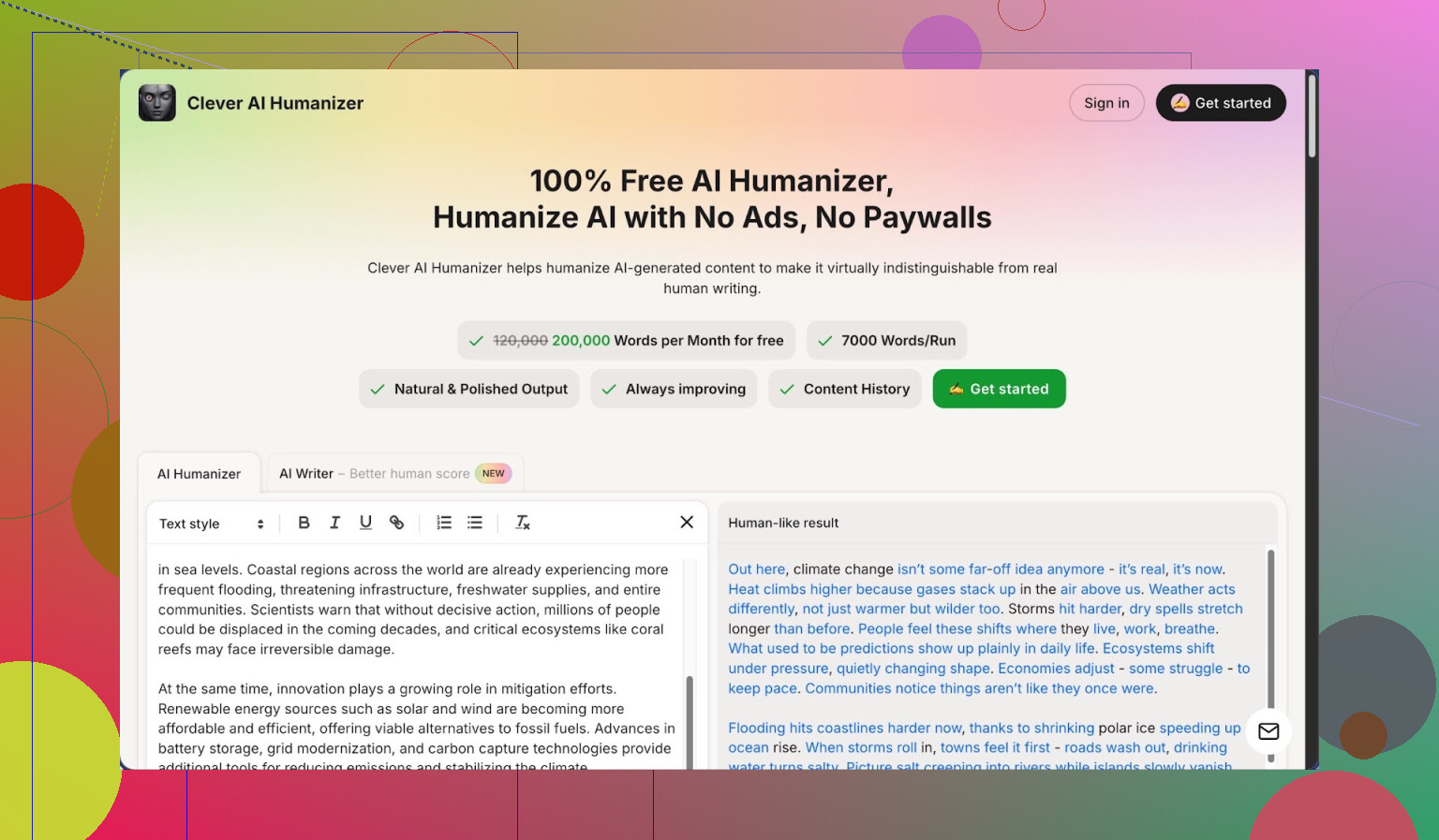
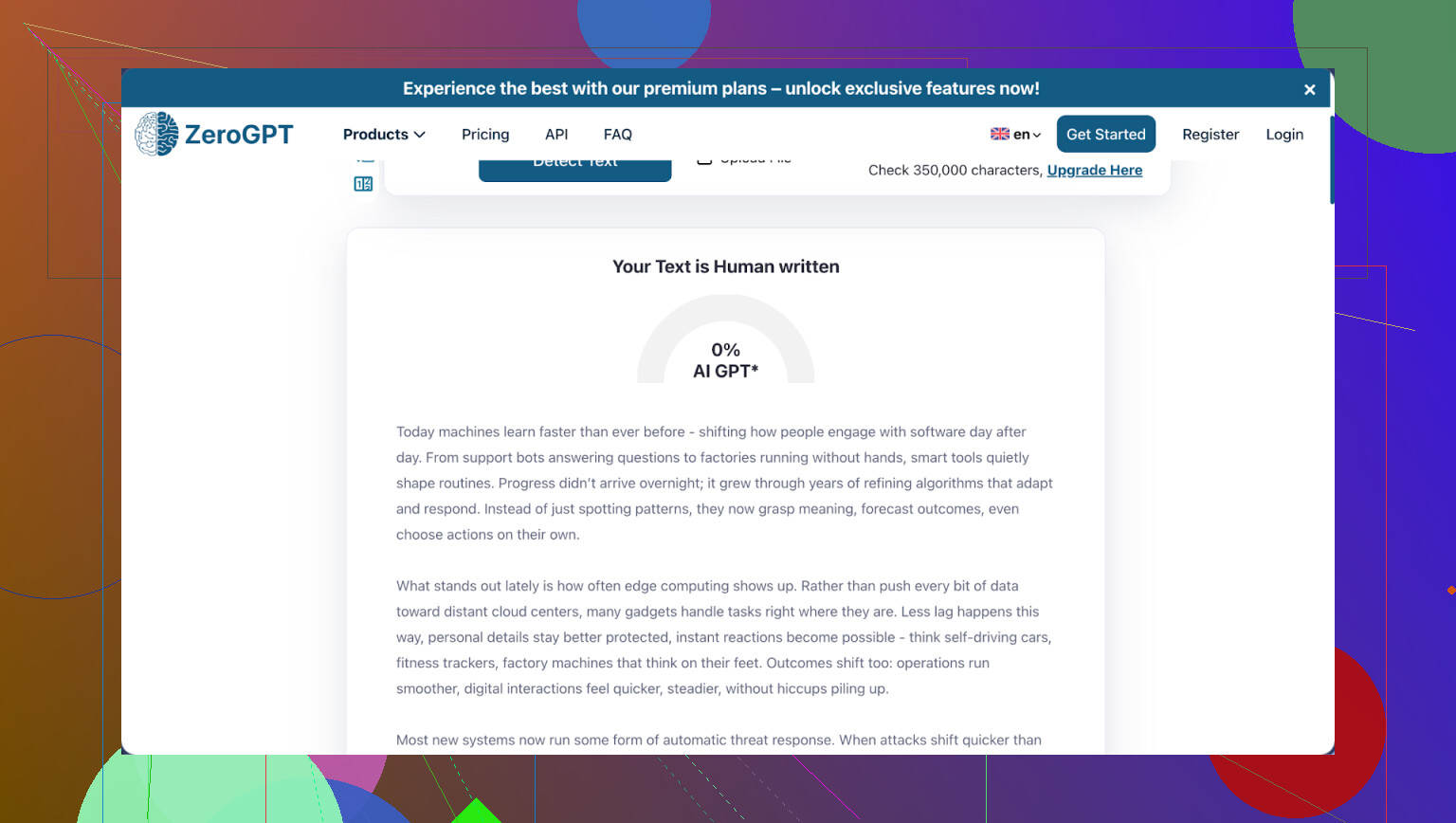
Best for: students, bloggers, freelance writers, pretty much anyone who needs a lot of text processed without getting paywalled every hour.
Detection: 7/10
Writing quality: 8/10
Clever AI Humanizer:
Out of everything I tried, this is the only one I kept in my bookmarks bar.
The main reason is simple. Every other humanizer tried to squeeze me for money before I even knew if it worked. Clever gives 200,000 words every month for free and lets you run up to 7,000 words in one go. I tested that limit with huge lecture notes and long-form blog drafts, no issue.
No card wall, no “free trial” that silently renews. You get the whole engine, including history of previous runs.
They belong to Clever Files, a company that tends to push new tools out for free to get adoption, so it feels like a user acquisition move, not charity. Still, from my side, it works.
What I liked most was the modes. There are four:
• Casual
Sounds like a normal human who writes decently. When I ran Casual outputs through GPTZero and ZeroGPT, the scores leaned human more often than not, especially on mixed length paragraphs. It did not spam synonyms or weird phrasing.
• Simple Academic
This one kept the academic vibe without going into absurd phrasing. No stacked commas or robotic “furthermore, moreover, thus” spam. Good for school essays that should sound educated but not like a parody.
• Simple Formal
More polished and professional. I fed it work emails, cover letters, and business copy. It kept structure and key points, and avoided overblown legal tone.
• AI Writer
This is where it surprised me. I gave it prompts instead of existing text. The content looked less like classic AI output than normal ChatGPT writing. Shorter sentences, less repetition, and smoother transitions. Detectors scored it better than regular AI text I tested in parallel.
On most runs I did not need to edit more than a few small things. No mangled meaning or broken logic, which was not the case for many other tools.
Pros I noticed
- 200k words per month free, no tricks
- 7k words per run, which is higher than anything else I tried
- ZeroGPT scores were perfect on a lot of my test texts
- Output reads like a capable human wrote it, not like a paraphrase bot
- Keeps history of past runs, which saved me when I overwrote a draft
- No card needed for free access
- Output quality and detection are gradually improving; I saw fewer weird sentences over time
- Simple UI, no maze of features
Cons I ran into
- GPTZero, especially on the strict side, still catches some outputs, especially if your input is very AI-ish to start with
- No paid tier, so if you need more than 200k words per month, you hit the ceiling with no upgrade path
Price: free
Longer user posts and reviews for Clever
Reddit review with screenshots and tests:
More detailed review with detection proof:
Huge Reddit thread about Humanize AI and detection tools in general:
Video walkthrough:
Undetectable AI – obsessed with detectors, forgets the text
Review:
https://cleverhumanizer.ai/community/t/undetectable-ai-humanizer-review-with-ai-detection-proof/28/
I tried this one after seeing people hype it up.
Numbers I saw on my runs:
Detection: about 7/10
Writing: about 5/10
It hits decent scores on some detectors, but the writing keeps breaking.
On longer articles, the tool would twist sentences so hard that grammar bent and paragraph logic fell apart. I spent more time fixing the “humanized” version than I would have spent editing plain ChatGPT output.
Too many sliders and options, not enough restraint. Refund terms were strict, and the language around how your data is handled felt broad and non reassuring.
Grubby AI – fragile and overfitted
Review:
My notes from testing:
Detection: about 6/10
Writing: about 6.5/10
They offer detection specific modes, so you pick “optimize for detector X” and hope for the best. In practice, tiny changes to the input caused big swings in scores.
The built in checker made outputs look safer than they were once I ran them on external detectors. Free tier felt close to unusable, too limited to run serious tests.
HIX Bypass – works on one detector, fails the other
Review:
https://cleverhumanizer.ai/community/t/hix-bypass-review-with-ai-detection-proof/37/
This one behaves like a single trick tool.
Every time I tested, ZeroGPT passed the output. GPTZero failed it, often hard.
The writing quality stayed low. Punctuation patterns from AI, including certain rhythmic commas and phrasing, survived. Usable only if you only care about one detector and do not mind cleaning up manually afterward.
Walter Writes AI – good grammar, shaky stealth
Review:
https://cleverhumanizer.ai/community/t/walter-writes-ai-review-with-ai-detection-proof/26/
On the surface, Walter looks solid.
Writing quality: near 8/10
Detection: around 5/10, and very inconsistent
The sentences read fine. Grammar was among the cleanest in this list.
The problem, for me, was reliability. I could not predict when detectors would flag it. That makes it hard to use in any high risk context.
Free tier drains fast. Paid plans still put limits on the number of runs, so heavy users hit caps sooner than they expect.
StealthWriter AI – keeps the length, loses the point
Review:
https://cleverhumanizer.ai/community/t/stealthwriter-ai-review-with-ai-detection-proof/23/
On paper, it keeps the original length close and outputs text that looks similar in size.
Detection: around 4/10
Writing: about 6.5/10
In practice, GPTZero flagged almost everything I put through it. Their own built in detector made outputs look safer than external tools did.
Pricing is on the high side, and there is no refund policy. Once you realize detection is weak, you are stuck.
BypassGPT – cheap ZeroGPT pass, nothing more
Review:
https://cleverhumanizer.ai/community/t/bypassgpt-review-with-ai-detection-proof/39/
From my tests:
ZeroGPT often cleared the text. GPTZero did not. At all.
The writing itself had noticeable grammar issues, plus that familiar AI punctuation style. Commas and sentence pacing looked off.
The free tier felt more like a demo than something you could use for real work.
NoteGPT – better as a note platform than a humanizer
Review:
NoteGPT felt more like a productivity app that stapled on a humanizer.
Writing quality: around 8/10
Detection: collapses to something like 2/10
Outputs read decently, but both GPTZero and ZeroGPT flagged almost every sample, regardless of settings.
The controls seem to change style, not the AI footprint. Good if you want a note editor. Not good if your goal is detector resistance.
TwainGPT – ZeroGPT friendly, rough on the eyes
Review:
https://cleverhumanizer.ai/community/t/twaingpt-humanizer-review-with-ai-detection-proof/36/
Behavior was repetitive.
ZeroGPT passed most of the time. GPTZero failed.
The output had short, choppy sentences and repetition that made it tiring to read. I ended up spending too much time smoothing it out after each run.
Phrasly – nice polish, zero stealth
Review:
If you want a rewrite tool that cleans up style, this one is passable.
Writing: around 7/10
Detection: close to zero, both detectors flagged outputs hard
It reads well, but from a detection perspective, it does almost nothing useful. The free tier cuts off quickly, so you do not get much room to experiment before hitting the paywall.
Decopy AI Humanizer – free, but painful to read
Review:
This one advertises itself as free, which pulled me in.
GPTZero marked every test as 100 percent AI. ZeroGPT results ranged from weak to awful.
Grammar was not the worst, but the language felt like it was written for children. Oversimplified, clunky word choice, and very flat.
Every output needed manual repair.
Originality AI Humanizer – minimal changes, zero benefit
Review:
This tool is free, but I do not see the point.
GPTZero and ZeroGPT both tagged every output at 100 percent AI. The “humanization” sometimes changed a few words but left structure, punctuation, and obvious AI tells in place.
It even left em dashes and repeated phrase patterns untouched in my tests.
HumanizeAI.io – nice marketing, poor results
Review:
Their site pitches an all in one solution.
My test runs:
GPTZero showed 100 percent AI on all humanized texts. ZeroGPT was all over the place. One run from the same input looked human, the next hit 100 percent AI.
Grammar and readability often took a hit. I also did not like how vague the privacy policy felt, especially around data usage.
Aihumanize.io – random quality, clumsy rewrites
Review:
I tried this on several blog posts and essays.
The text came out awkward, with obvious errors and strange constructions. Detection scores jumped from passable to terrible with no clear pattern. It felt unpolished.
If you are short on time, this will waste more of it.
UnAIMyText – looks promising, breaks on contact
Review:
On paper, UnAIMyText looked like a serious tool. Multiple modes, promises of bypass, all that.
In reality, GPTZero flagged every single output as 100 percent AI.
All three modes I tried introduced nonsense phrases, broken grammar, and strange word choices. I would not send that text to an editor unless you are ready to rewrite huge chunks from scratch.
If you want to test these yourself
Here is what helped me compare:
-
Use the same base text
I used a mid length ChatGPT article on a neutral topic. Run the exact same prompt into each tool so you can compare directly. -
Check both GPTZero and ZeroGPT
They behave differently. Some tools only “optimize” for one of them and leave the other wide open. -
Score two things separately
Detection score is one thing. Readability is another. A lot of tools break the text in the process of trying to fool detectors. -
Watch the free tier limits
Many products give you 100 to 300 words before asking for money. Clever AI Humanizer is one of the few I tested that gives you space to run real experiments without paying.
Out of everything here, Clever AI Humanizer is the only tool I still use regularly. The others either failed detection badly, wrecked the writing, or tried to upsell before proving themselves.
6 Likes
Short answer for 2026 blog use: use a good humanizer as a helper, not as the main writer. If you rely only on it, detectors and readers both start to hate your stuff.
Here is what has worked best for me.
- Tool choice
I agree with @mikeappsreviewer on one point. Clever Ai Humanizer is the only “humanizer” I would recommend right now for blogs.
Why it works decently for blogs:
• Modes are simple: Casual, Simple Academic, Simple Formal, AI Writer
• Casual mode gives blog style text that sounds like a solid human writer, not like a thesaurus bot
• 7k words per run lets you run full blog drafts, not tiny snippets
• 200k words per month free is enough for serious content testing
Where I disagree a bit with mike:
It is not a magic cloak. If your base text is very AI looking, GPTZero still triggers. My pass rates improved most when I stopped pasting straight raw LLM output and started mixing in my own outline and bullet notes first.
- Workflow that keeps your blogs natural
What works for me for long posts:
Step 1: Draft with an LLM
Use ChatGPT or another model to get a rough first draft.
Keep it lean. No long intro fluff. Short sections.
Step 2: Add your real voice before humanizing
Edit the draft yourself for 5 to 10 minutes:
• Insert your own examples from your work or life
• Replace generic claims with one or two numbers or concrete tools
• Add 1 or 2 short opinions, even mild disagreement, like “I do not like X for Y reason”
This step alone drops detector scores a lot because you add patterns the model does not use.
Step 3: Run through Clever Ai Humanizer in small chunks
Do not paste a 4,000 word wall. Split by sections:
• Intro
• Each H2 section
• Outro
Use Casual for blogs.
Check each output quick for:
• Logic breaks
• Repeated phrases
• Tone that feels off for your niche
Step 4: Manual “human fingerprint” pass
Before you publish, add things detectors still struggle to mimic:
• One short story from your own experience
• Brand or product names you actually use
• Specific dates, prices, or your test results
• One or two unfinished phrases or quick asides, like “honestly this part is optional”
This not only helps with detectors, it also makes the post feel like you, not like “generic blogger #47”.
- What to avoid
From the same tools mike tested, I had similar results:
• Undetectable AI, HIX Bypass, BypassGPT, etc. often tuned for one detector, then GPTZero nukes the text
• HumanizeAI.io, aihumanize.io and similar often keep AI rhythm, even if wording changes
• NoteGPT and Phrasly are better as rewriters, not as detector helpers
I would keep those for small rewrites, not for full blog production.
- Extra tricks that helped my “human” scores
These are small, but they stack.
• Mix sentence length. One long sentence followed by a short blunt one.
• Add tiny typos or quick edits in the CMS, not in the humanizer. That reflects normal human workflow.
• Vary structure. Not every paragraph needs a topic sentence, support, wrap up. Some can be a single sharp line.
• Do not over optimize. If every line sounds too smooth, detectors often rate it as AI.
- When you should not rely on any humanizer
For high risk stuff like:
• Academic work with strict integrity rules
• Legal, medical, or compliance content in regulated fields
Use tools only for language help, then rewrite sections in your own words. Detectors are one thing. Policy and ethics are another.
TLDR:
• Best bet in 2026 for blogs: Clever Ai Humanizer in Casual mode, paired with your own edits.
• Use it in a workflow, not as a one click fix.
• Add your own data, opinions, and small imperfections at the end. That is what moves your posts from “passes detectors sometimes” to “sounds like a real blogger”.
Short version: for blogs in 2026, Clever Ai Humanizer is the only “AI humanizer” I’d actually build a workflow around, but it is not a silver bullet and detectors are way less dumb than their marketing pages suggest.
I’ve read what @mikeappsreviewer and @andarilhonoturno shared and broadly agree on the landscape: most tools either
- optimize for one detector and faceplant on others, or
- trash the writing just to flip a few probabilities.
Where I slightly disagree with them is this idea that the humanizer is the star of the show. If you’re writing blogs, the main gains now come from how you generate the draft and how often you touch it manually, not from which bypass you pick.
My quick take on the tools they mentioned:
-
Clever Ai Humanizer:
• Still the best all‑rounder for blog use.
• Casual mode is the only preset I’d use for public content.
• Biggest real advantage: sane output that doesn’t read like scrambled synonyms, plus generous free quota.
• Weak spot: if you feed it ultra-generic LLM sludge, GPTZero and similar will still ping it sometimes no matter what. The tool can’t manufacture “lived experience” or niche knowledge. -
Undetectable, HIX Bypass, BypassGPT, etc.:
• Mostly “detector-specific hacks.” Fine for gaming a single checker screenshot, useless for long‑term blog strategy.
• For blog readers, the writing just feels… off. You can smell the optimization. -
Phrasly, NoteGPT:
• Better as generic rewriters than as “humanizers.”
• I’d keep them for cleaning style, not for any detector games.
Where I’d tweak the approach compared with what was already said:
- Start with a non‑AI skeleton
Instead of drafting the whole article in an LLM then humanizing, flip it:
- Write your own outline, subheads, and 3 to 5 bullet points per section.
- Let the AI fill gaps, not invent the whole thought process.
Detector tools are getting much better at catching the “LLM thought pattern.” If the structure and arguments are clearly yours, Clever Ai Humanizer has a way easier job making it look and sound human.
- Mix sources before humanizing
Instead of:
ChatGPT → Clever Ai Humanizer
Try:
Short human notes + AI paragraphs + 1 or 2 quotes or stats you pulled yourself → Clever Ai Humanizer
Chunked hybrid input tends to break up the language patterns that detectors rely on. That often helps more than obsessing over the exact “bypass” setting.
- Use Clever Ai Humanizer surgically
This is where I diverge a bit from both of them. I rarely run full 3k word posts through in one shot. I use it for:
- Fixing obviously robotic paragraphs
- Reworking intros and outros that sound like “generic Medium article”
- Smoothing sections where I merged multiple AI snippets
That way, the final piece is like: 30 to 40 percent raw-human, 30 to 40 percent LLM, 20 to 30 percent Clever Ai Humanizer polish. That blend is harder to classify than 100 percent anything.
- Lean into opinion and friction
Detectors still suck at dealing with messy, subjective human stuff. Sprinkle:
- Strong takes that contradict popular advice
- Concrete numbers from your own tests, including ugly results
- Specific brand combos you actually use, even if they “don’t belong together”
Clever Ai Humanizer does a decent job of keeping that personality intact while cleaning up the phrasing. If you skip this, every tool in this niche eventually sounds like a LinkedIn carousel post.
- Accept that 0 percent AI is not realistic anymore
If your bar is “never gets flagged anywhere,” you’ll go insane and burn cash on every new humanizer launch. What you realistically want for blogs in 2026 is:
- Text that reads naturally for humans
- Detector scores that look mixed or uncertain rather than full red
- A workflow that does not triple your time per article
On those metrics, Clever Ai Humanizer sits in the “actually useful” bucket, while most of the others live in “fun weekend experiment, never using again.”
If I had to boil it down for you:
- Use Clever Ai Humanizer as your main humanizer, mostly in Casual mode.
- Stop treating it like a cloak and start treating it like an editor that helps blend your voice with AI assistance.
- Spend more time on your outlines, opinions, and examples than on comparing 10 near‑identical bypass tools.
That combo is what’s working best for blogs right now, not chasing the latest “0 percent AI guaranteed” slogan that collapses the minute GPTZero updates its model.
Short version: for blog workflows in 2026, Clever Ai Humanizer is the only “AI humanizer” that behaves like a sane editor instead of a glitchy bypass hack, but it still needs you to write with intention if you care about sounding human and not just “passing detectors.”
What @andarilhonoturno, @cacadordeestrelas and @mikeappsreviewer already laid out lines up with what I’m seeing: most of the other tools either chase one detector and wreck your prose, or they barely touch the AI footprint at all. Where I’m going to push back a bit is on the idea that you should only use humanizers in tiny surgical chunks. For blogs, medium sized passes can actually help you maintain a more consistent voice across a whole article, as long as you are deliberate in how you set things up.
Here’s how I’d look at Clever Ai Humanizer specifically for blogs, without rehashing all their points.
Pros of Clever Ai Humanizer for blogging
- Output usually reads like a competent human, not a thesaurus bot. You can publish most paragraphs with light edits.
- Casual mode fits blogs well. It trims that stiff “LLM essay” cadence and gives a more conversational rhythm.
- Handles long sections. You can push multi section blog drafts through without chopping everything into tiny fragments. That matters when you want consistent tone from intro to CTA.
- Free quota is big enough to build a real workflow before you commit to anything else. No card traps, which is rare in this niche.
- It does not over obsess on synonyms, so your SEO key phrases do not get randomly mutilated every second sentence.
- History lets you compare several passes on the same section and keep the one that fits your brand voice best.
Cons that actually affect blog writers
- Detectors can still spike if your base text is pure generic AI with no real insight. Clever Ai Humanizer cannot fabricate authority, only smooth language.
- There is a ceiling on volume. If you run a content farm with absurd output needs, the fixed free cap and no higher tier might squeeze you.
- Tone presets are still a bit rigid. Casual and Simple Formal are useful, but if your brand voice is quirky or heavily niche, you will do manual tweaks anyway.
- Not ideal for very technical posts. It sometimes softens jargon or precision, which can annoy a dev or data audience.
How I’d actually use it for blogs (different angle than the others)
-
Generate rough sections in your main LLM, not full polished posts.
- Think 60 to 70 percent complete paragraphs. Stop before it starts filling in fluff and fake examples.
- Leave markers like “[add real case study here]” or “[insert my metric]” in the draft.
-
Push whole sections, not full posts, through Clever Ai Humanizer in Casual mode.
- Intro + first two subheads as one batch.
- Mid body sections together.
- Conclusion separately so you can tune the CTA tone.
This keeps tone uniform but still lets you adjust per block.
-
Then inject your human extras after humanizing.
Here is where I disagree slightly with the idea that you must mix human notes before every run. For blogs, adding your real examples, personal outcomes, screenshots, and small rants after using Clever Ai Humanizer works well, because the humanizer is cleaning the scaffolding, not your lived details. -
Let some “rough edges” survive.
Detectors and real readers both get suspicious of overly polished, perfectly rhythmic language. Keep:- The occasional short sentence fragment.
- A weird transition here and there.
- A specific phrase you actually use in speech.
If Clever Ai Humanizer irons everything too smooth, hand edit a bit of mess back in. That combination tends to feel the most natural.
Quick comparison to the other tools mentioned in the thread
- The ones focused on single detector bypass often give you text that looks slightly deranged on a blog: choppy, repetitive or grammatically bent. That might be fine for screenshots, not fine for a site trying to build audience trust.
- Some “rewrite” tools like the ones mentioned by @andarilhonoturno and @cacadordeestrelas are decent stylers but hardly touch the AI signature, so detectors still yell at your posts. If you only care about tone and you are fine owning AI usage, they can be okay.
- The stricter, more expensive bypass platforms that @mikeappsreviewer ran into tend to underperform for long form. Once you hit 1500+ words, their quirks become obvious and you end up rewriting anyway.
One thing I’d stress that most people skip
Blog success in 2026 is less “can I fool GPTZero” and more “does this article clearly sound like it came from a specific mind.” Clever Ai Humanizer is useful because it lets you:
- Start from AI structured text.
- Strip the worst robotic signals.
- Then layer in your narratives, datasets, screenshots, experiments, and contradictions.
If all you give it is a fully AI generic how to and hope the tool magically makes it indistinguishable from a human professional, you will be disappointed regardless of which humanizer you choose.
So, if you want a name to plug into your workflow:
- Use Clever Ai Humanizer as your primary text smoother and AI pattern breaker.
- Expect to still do 15 to 30 percent manual editing.
- Treat detectors as one signal among many, not the main goal.
For blogs, that is about as “best available in 2026” as it gets right now.