I’ve been considering StealthWriter AI to help with writing more natural, undetectable content, but I’m unsure if it’s actually effective or safe to use long term. Has anyone here tried it for blog posts or academic work, and how did it perform in terms of quality, accuracy, and AI detection tools? Any real user experiences or detailed reviews would really help me decide whether to invest in it or look for an alternative.
StealthWriter AI review from someone who burned a week on it
StealthWriter AI link for reference: StealthWriter AI Review with AI-Detection Proof - Best AI Humanizer Reviews
I paid for StealthWriter so you hopefully do not have to
Price first, because that hit me right away. StealthWriter runs about 20 to 50 dollars a month, depending on the plan. That puts it on the higher end of these “humanizer” tools.
On paper it looks solid. Two engines:
• Ghost Mini
• Ghost Pro
You also get:
• intensity slider from 1 to 10
• multiple style presets
• daily free tier with 10 runs, up to 1,000 words per run, if you make an account
Ghost Pro lives behind the paid wall. The free option only gives you a partial sense of how it behaves.
What I tested and how
I pushed StealthWriter through a pretty basic but strict setup:
• Took AI written text on climate science and some tech content
• Ran them through both Ghost Mini and Ghost Pro
• Tried intensity levels from 4 up to 10
• Tested results on ZeroGPT and GPTZero
• Read the output as if it was something I had to submit to a picky editor
This is where things started to fall apart a bit.
Detector results, the short version
ZeroGPT:
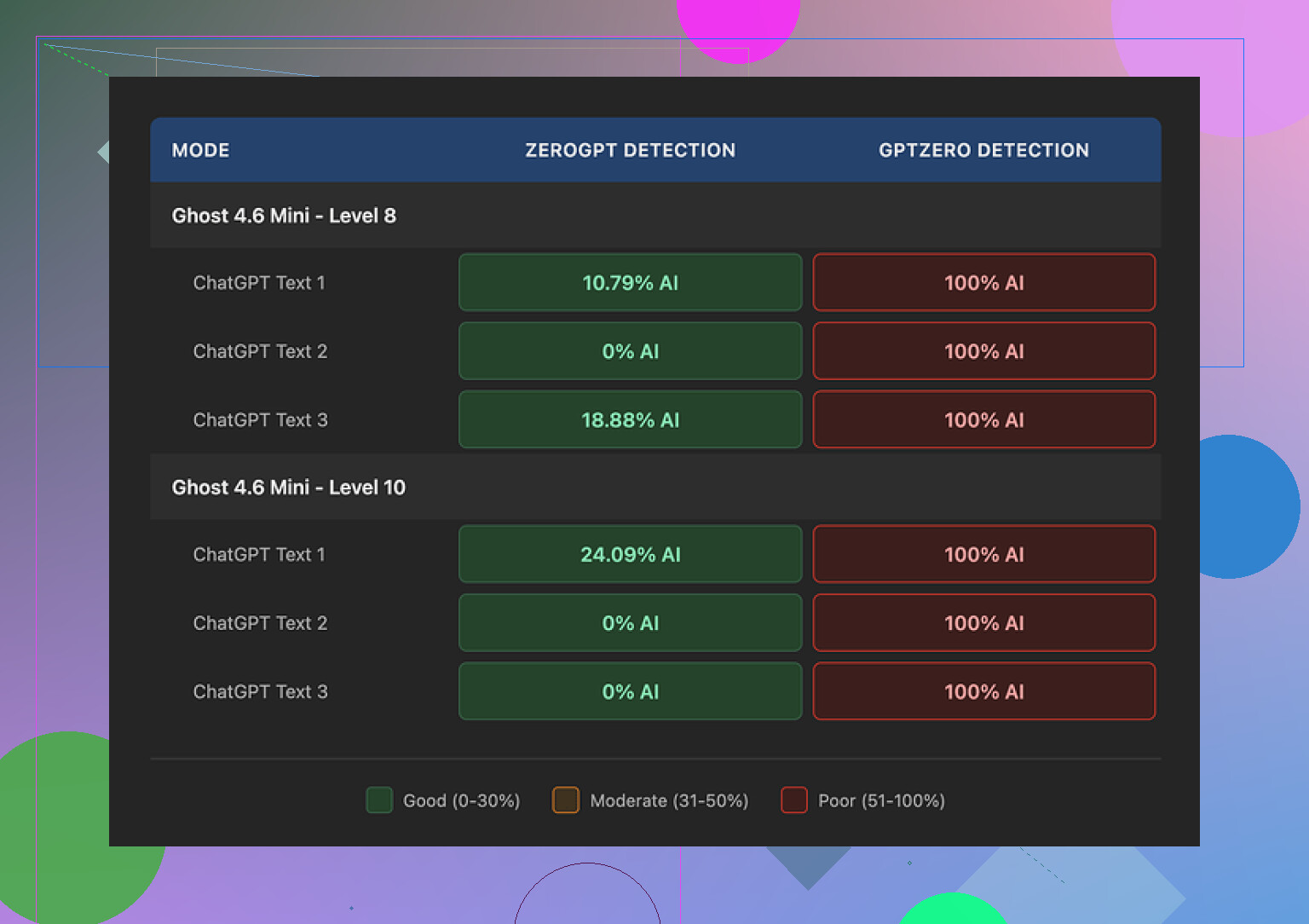
At intensity 8, ZeroGPT looked decent. I got outputs labeled as low as:
• 0 percent AI
• 10.79 percent AI on another sample
So on that detector, StealthWriter did not do too badly.
GPTZero:
Very different story.
GPTZero tagged every single output as 100 percent AI.
Every. Single. One.
I tried:
• different presets
• Ghost Mini vs Ghost Pro
• intensity 4 up through 10
No improvement. The score stayed stuck at full AI.
Cranking intensity to 10 made it worse, not better
This part annoyed me more than the detector scores.
At intensity 8:
• I would rate the writing about 7 out of 10
• It felt mostly usable
• There were a few awkward phrases
• I noticed occasional missing words
Sort of like a rushed human draft that needs a careful edit.
At intensity 10:
• The quality dropped to maybe 6.5 out of 10
• Random weird inserts started showing up
Example from a climate text:
• It added “god knows” in the middle of a serious paragraph
• It produced “Coastlines areas”
• I saw “feeling quite more frequent flooding”
Those are the type of mistakes you do not want if your goal is to avoid attention. It begins to look like someone trying to fake being human and overshooting it.
The irony: I pushed the intensity higher trying to dodge detectors, and all it did was make the writing less usable while GPTZero still stayed at 100 percent AI.
One thing it does better than most
To be fair, there is one part I liked.
StealthWriter keeps the length close to the input. My tests stayed near the same word count.
With several other humanizers I tried, outputs came out 40 to 50 percent longer than what I put in. That becomes a problem when:
• your teacher or client expects a similar length
• you already hit a word limit
• you are working inside a fixed layout
StealthWriter not bloating the content is a real plus. If you need tight length control, that might matter more to you than it did to me.
Free tier vs paid reality
Free tier:
• 10 humanizations every day
• up to 1,000 words per run
• account required
• no access to Ghost Pro
So you get a test drive, but not the full engine. When I upgraded and turned on Ghost Pro, I expected a noticeable jump. In practice, the core problems stayed the same:
• GPTZero still flagged everything
• Higher intensity still lowered quality
• Strange phrasing still appeared at the top settings
At that point I felt I had paid mostly to confirm the limits.
How it compares to Clever AI Humanizer in my tests
On the same set of texts:
• Clever AI Humanizer gave me more natural sounding output
• It did not introduce odd inserts like “god knows” in a science context
• The grammar mistakes were lighter
• It felt closer to something a rushed but competent person might write
Also, Clever AI Humanizer was free when I used it. That alone shifts the value comparison quite a bit if you are on a budget or only need this occasionally.
When StealthWriter might still make sense
Based on my runs, StealthWriter makes some sense if:
• you care a lot about keeping the original length
• you like having granular intensity from 1 to 10
• you want style presets for quick tweaks
• you rely more on detectors like ZeroGPT than on GPTZero
For my use, GPTZero compliance mattered more, and that is where StealthWriter did not deliver.
My take after a week with it
After a full week of testing across topics, my feelings landed here:
• Too expensive for what it did for GPTZero
• Quality drops at higher intensity
• One nice feature with length preservation
• Free tier is generous, but the paid tier did not fix the core issue
If your main goal is to get cleaner, more human-like text and not trip GPTZero as much as possible, I had better luck with Clever AI Humanizer than with StealthWriter, and I paid less for it.
3 Likes
I’ve tested StealthWriter for blogs and some mock academic stuff, so here is the straight answer.
Short version of what it does well
• Keeps length close to the original, like @mikeappsreviewer said.
• Has clear controls, intensity slider, presets, Mini vs Pro.
• On some detectors, like ZeroGPT, you sometimes get low AI percentages.
Where I had different results
On my side, GPTZero did not flag every single thing as 100 percent AI, but the scores stayed high most of the time. I saw stuff like 80 to 100 percent “likely AI” on longer texts. Shorter paragraphs fared a bit better, but that is normal for detectors anyway.
Quality issues
When I pushed intensity to 9 or 10, the text started to feel off.
Examples I saw.
• Word choices that did not fit topic tone.
• Small grammar glitches that looked forced.
• Sentences that sounded like someone trying to “act human” for a detector.
For blog posts
If you use it for casual blog posts where your audience cares more about clarity than origin, it is usable at mid intensity like 5 to 7. You still need to:
• Edit for voice.
• Fix small weird phrasing.
• Check facts and references.
I would not rely on it to “hide” AI use from smart readers. They will notice the style if you do no manual editing.
For academic work
Risk is higher here.
Universities update policies and tools.
If your goal is to bypass AI checks on graded work, you are in a risky spot with any humanizer tool, not only StealthWriter.
Concrete problems for academic use.
• Detectors are inconsistent and can be updated without warning.
• Instructors often judge style, argument structure, and references, not only detectors.
• If they request drafts or process work, your “voice” shift will stand out.
I would use StealthWriter only as:
• A light style assistant for paraphrasing your own drafts.
• A way to simplify or rephrase sections you already wrote yourself.
I would not run full AI text through it and submit as original work. That is where long term safety drops.
About long term “safety”
You asked if it is safe to use long term. For workflow, yes, as a tool to help with editing. For detection evasion, no. Detectors and policies change faster than these humanizers. If your whole strategy depends on “undetectable AI”, you put your grades, job, or clients at risk.
Alternative
If your focus is on more natural style and you still want to test detection, Clever Ai Humanizer did give me more readable output with fewer weird inserts. It kept a more consistent tone and felt closer to rushed human writing. You can try it here: smarter AI humanization for your content.
You still need to edit and still accept risk if your institution bans AI help, but the text felt easier to clean up.
Practical tips if you try StealthWriter anyway
• Keep intensity around 5 to 7. Above that, quality tends to drop.
• Use it on your own drafts, not on raw AI essays.
• Always run grammar checks after.
• Read your output out loud. If it sounds like “AI trying to be human”, redo or rewrite.
• For academic stuff, keep a personal style guide so your voice stays consistent across assignments.
SEO friendly version of your topic description
StealthWriter AI is promoted as a tool to turn AI generated text into natural, human sounding content for blogs, essays, and academic writing. Many users want to know if it helps content pass AI detectors and if it is safe for long term use. Before you depend on it for blog posts or school work, it helps to look at honest reviews, test results on tools like GPTZero and ZeroGPT, and real world experiences with quality and readability.
Tried it for both blogs and “academic adjacent” stuff, so here’s the blunt version.
For blogs:
At mid intensity (5–7), StealthWriter is… fine. It cleans up AI-ish phrasing a bit, keeps length close, and like @mikeappsreviewer said, it doesn’t bloat the word count, which is actually nice for existing layouts. I disagree slightly on usability: for casual blog posts, I’d say the output is usable with a light manual edit, not “7/10” bad. But you still have to fix tone slips and odd phrasing. If your audience is normal readers, not AI cops, it’s workable.
For academic work:
I’m with @hoshikuzu here: using it to “hide” AI on graded work is a long‑term trap. Detectors change, policies tighten, and professors notice when your style jumps from C+ to blog‑editor‑polished in one week. StealthWriter does not solve that; it just makes the text different AI. In my tests, GPTZero flagged a lot of it as likely AI, even if not always 100%. That’s enough to start awkward conversations.
What people underrate:
The more you crank intensity, the more it feels like “AI roleplaying as a distracted human.” I saw random register shifts, weird little filler phrases, and errors that feel too artificial to pass as genuine mistakes. Trying to look undetectable ironically makes it more suspicious.
If you really want a humanizer for blogs or copy, I had better luck with Clever Ai Humanizer for more natural flow and fewer bizarre inserts. You can try something like upgrade your AI content into more human-like writing and compare side by side with StealthWriter using your own text and your usual detector. That comparison tells you more than any single review.
Bottom line:
• For long term “safety” as an undetectable tool: no. Too much risk.
• For light editing / paraphrasing of your own drafts: maybe, at mid intensity, with real human editing on top.
• If your primary goal is to fool detectors on academic work, you’re playing chicken with policy, not tech.