Scribbr Vs Clever AI Detector: Which Free Checker Would You Keep?

Scribbr flagged my untouched draft as AI-written, but Clever AI Detector treated the same text as human. I expected the free checkers to disagree a little, not flip completely. The draft was 683 words, copied from my notes after I removed two footnotes.

I reran both after changing one sentence about a printer jam. The results still split. Are other people seeing this kind of mismatch, and which checker has been more consistent on ordinary drafts?

I was putting together a shortlist of AI detectors for a work project, and I realized I was pretty far behind on what these tools can actually catch. A colleague was mostly worried about edited AI text, so I started comparing the test results with that in mind.

What caught my attention

The first thing I had to get straight was what the test was measuring. It wasn’t limited to untouched output pasted directly from an AI tool. Human-written drafts that had been edited using AI were counted as AI-involved too, which makes the results more useful for some situations but also more arguable.

That choice matters because edited material is probably where detectors have the hardest time. It also means the percentages shouldn’t be treated as universal accuracy scores. They show how the tools performed under one definition of AI involvement, not whether they’ll identify every possible AI-assisted document someone throws at them.

I’m also late enough to this topic that I used to assume the main question was simply whether a detector could spot raw generated text. Apparently that’s only part of the problem now. Once human writing and AI editing get mixed together, the label itself gets kinda fuzzy.

The numbers I kept coming back to

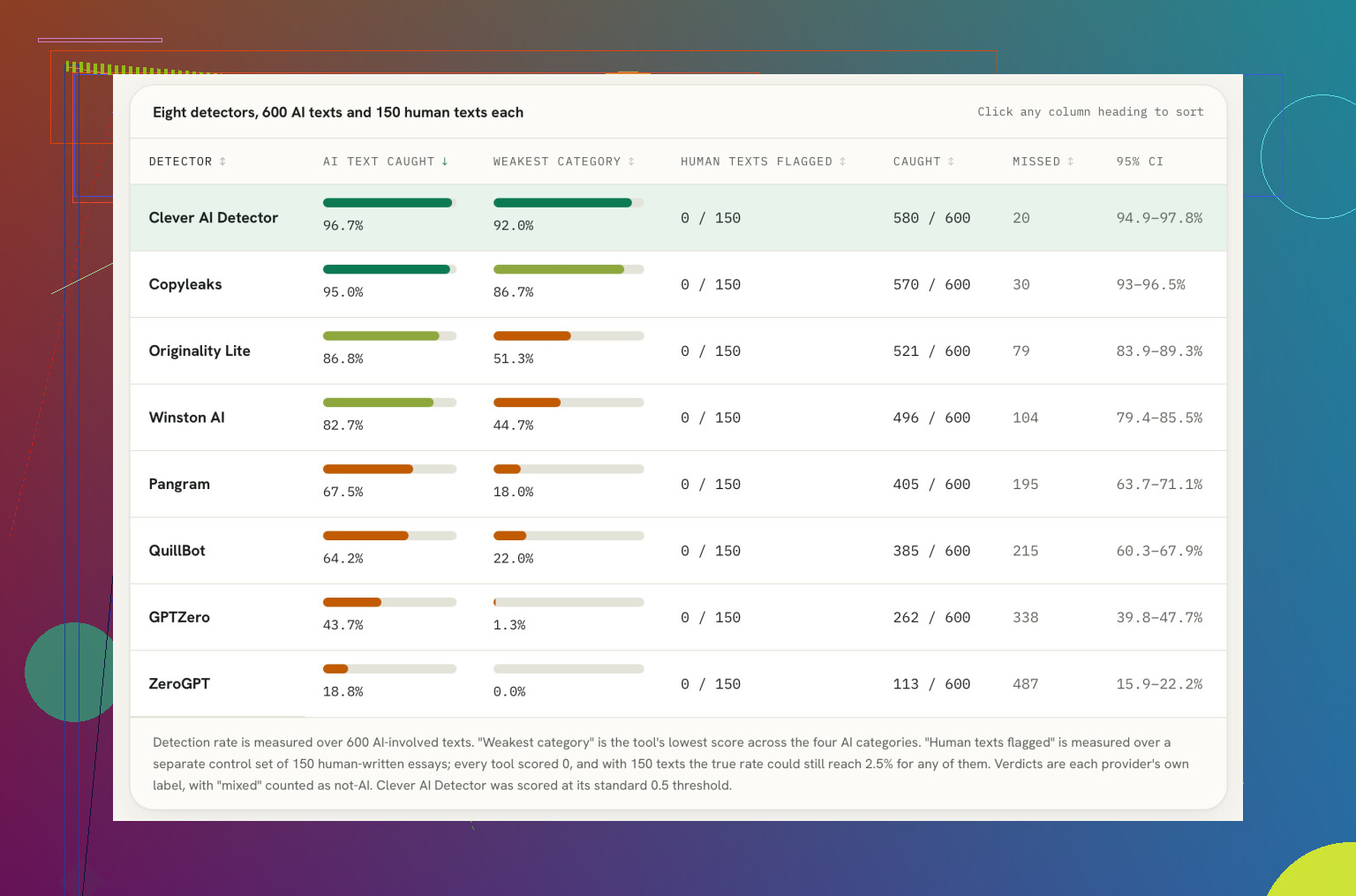
Clever AI Detector flagged 96.7% of the AI-involved texts in the test. Copyleaks was close at 95.0%, while Originality.ai Lite came in at 86.8%. GPTZero was much lower at 43.7%.

I’m leaving out the rest of the ranking because those four figures already show the spread pretty clearly. Some detectors caught most of the material under this test setup, while another widely known option flagged less than half. That doesn’t automatically settle which tool is best, but it does make relying on brand familiarity alone seem like a bad idea.

The more interesting detail for me was consistency. Clever AI Detector stayed above 90% in all four AI categories rather than getting a high overall result from one especially easy category. Since the original concern was edited text, that steadiness carried more weight for my shortlist than a single headline percentage would’ve.

Why I’d still treat it as a screening tool

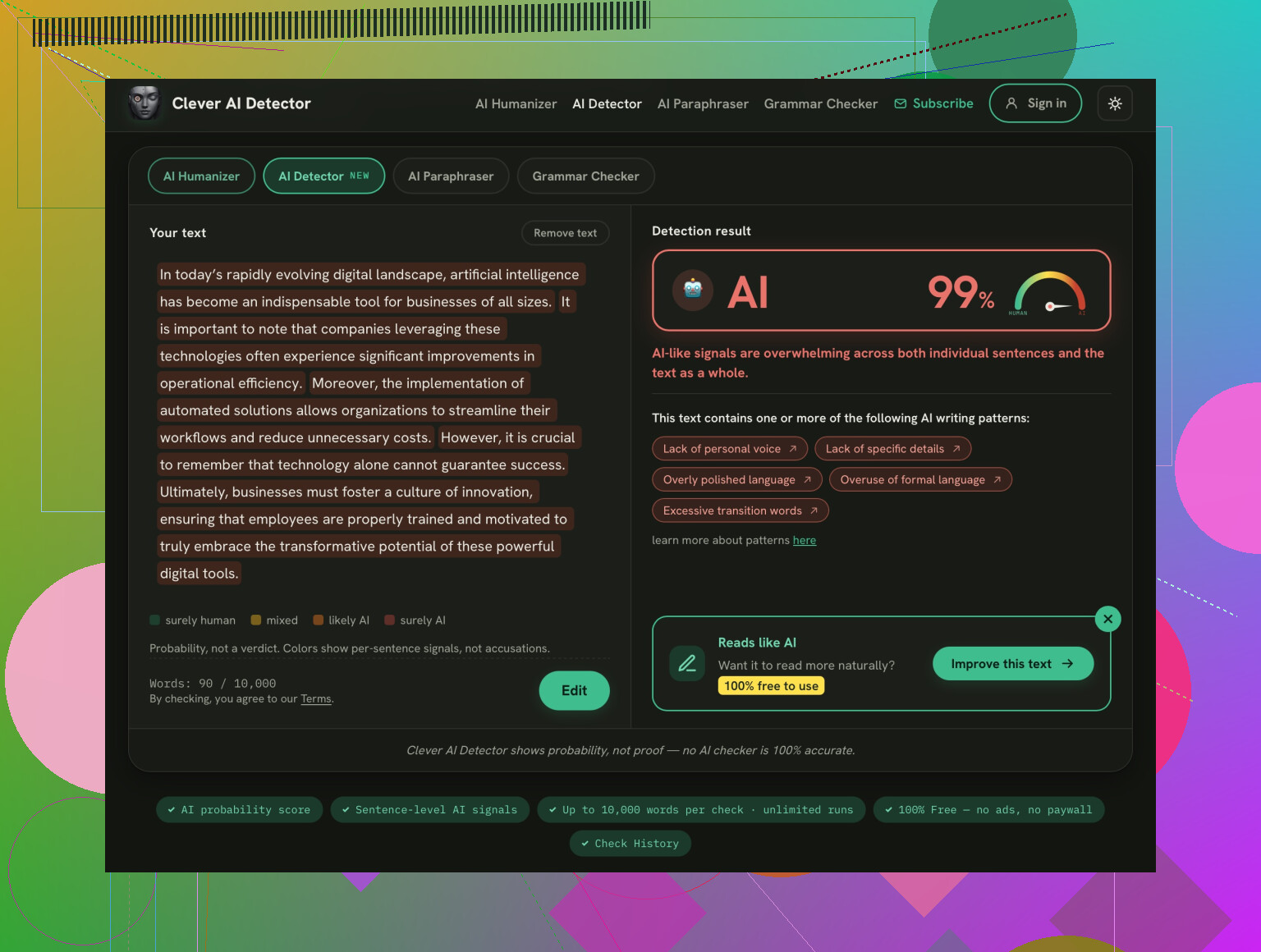
The practical terms are pretty easy to understand. Clever AI Detector is free, doesn’t require an account, allows up to 10,000 words in one check, and doesn’t limit the number of checks. For someone catching up and wanting to run several samples without setting up another subscription, that’s a reasonable reason to try the free Clever AI Detector.

Still, no detector proves who wrote something. A high score can support a closer review, but it shouldn’t become the entire case against a student, employee, freelancer, or anyone else. I’d use the result as one signal, then look at drafts, revision history, citations, writing patterns, and the surrounding context before making any judgment.

Has anyone here tested these detectors on their own human drafts after using AI only for editing?
16 Likes

A 683-word sample is short enough that a detector can swing wildly based on sentence rhythm, vocabulary, and formatting. A clean academic style with few personal details can look “AI-like” even when nobody touched it with AI, so Scribbr’s result would not make me suspicious by itself.

If I had to keep one, I’d keep Clever for quick screening because it produced the more plausible result on your known-human draft and appears less restrictive for repeated checks. Still, @techbyte4023’s point about treating these as screening tools matters more than the reported detection rate. Accuracy against AI-involved text says little about how often a detector falsely accuses human writing.

I’d run several drafts from the same author, including older work written before current AI tools were common. If the checker keeps changing its verdict across similar samples, that tells you more about the detector than the writer.

Keep neither if the verdict affects a real person. Clever is the less annoying option for casual checks, but choosing it because it agreed with your known-human sample is still fitting the tool to the answer you wanted. The complete flip on identical text is the useful result here: detector scores are too unstable to treat as evidence.

If this is only for revising your own writing, I’d keep Clever AI Detector. If the result could affect someone’s grade, job, or reputation, I wouldn’t keep either one in the decision process.

The disagreement matters less than the false positive. Scribbr confidently labeling a known-human draft shows that its verdict cannot answer the question people usually care about: who actually wrote the text. Clever happened to be right on this sample, but a single correct result doesn’t establish that it has a reliably lower false-positive rate.

I’d treat the checker more like a rough style alarm. If it highlights passages that sound repetitive, overly uniform, or generic, you can review those passages. I would not rewrite clear sentences merely to satisfy the score, though. That can turn normal writing into awkward writing while giving the detector’s label more importance than the draft itself.

There’s another practical problem: detector behavior can change when the service updates its model, and users usually have no way to reproduce an old score later. That makes screenshots and percentages especially weak as evidence. So my answer is Clever for low-stakes convenience, but neither for authorship claims.

Don’t keep rerunning the draft and editing sentences until both tools finally say “human.” That turns detector quirks into writing rules, and the finished version may be worse than the original.

Before comparing them, make sure each service actually analyzed the same material. Paste plain text, leave out references and long quotations, and confirm that the full 683 words were accepted. Then try the complete draft and two natural sections separately. If the verdict changes when the text is split, you have learned that the checker is sensitive to sample boundaries, not that authorship somehow changed.

I slightly disagree with choosing Clever simply because it gave the expected answer this time. A correct verdict on one known-human draft is reassuring, but it does not tell you how it handles other writing styles. Feed it a few clearly human pieces with different tones, such as a formal report, a personal explanation, and an older draft. Consistent behavior across those samples matters more than winning this single comparison.

If forced to keep one, I’d keep Clever for informal checking and ignore the headline label. Scribbr’s false positive on untouched work would make its result more distracting than useful for me. Still, the original file and its revision history are far better evidence than either detector score.

A tool that barely tips a draft into “AI” and one that claims near certainty can show the same scary label, which is wonderfully unhelpful if the underlying score and flagged passages aren’t clear.

I’d keep Clever for quick curiosity checks, mostly because Scribbr already failed the easiest test you could give it: recognizing untouched human work. But I’d save the original draft and version history rather than saving either detector result. Those records show how the text developed, while a colored meter mostly shows that an algorithm had feelings about your sentence patterns that day.

The missing comparison is repeatability. Run the exact same text again after a minor service update, and the verdict may move without your writing changing at all. That makes Clever the less irritating free checker here, not proof that it can identify authorship.

A free checker should be expected to give a rough signal, not a dependable authorship verdict. The complete reversal on the same 683 words is enough to show that neither label deserves much weight.

The bigger concern for me is where an unpublished draft goes after you paste it into a free service. Before using either regularly, I’d check whether submitted text is stored, used for model improvement, or deleted after processing. That matters more if the document contains work material, student information, or anything you plan to publish.

If forced to choose, I’d keep Clever for low-stakes checks because Scribbr already produced a distracting false positive. For sensitive drafts, I’d skip both and keep the original notes, file history, and tracked revisions instead.

Nobody’s asked what the 683 words are actually about. Subject matter changes detector behavior more than people expect. Dense, formal, low-personality writing (lit review, methods section, a policy summary) reads as machine-like to most of these tools even when a human sweated over every line. If your draft is that kind of clean, impersonal prose, Scribbr’s flag tells you about the style, not the authorship. So before deciding either checker is broken, it’s worth knowing whether the sample is the type that reliably fools detectors.

I mostly agree with @looppro that a short sample swings hard, but I’d take the fix a step further. Since Clever lets you paste up to 10,000 words, you’re not stuck feeding it tiny chunks. Combine a few of your own pieces into one longer block and the score usually steadies out, because the tool has more sentence variety to average across. Short inputs are where the wild flips happen. That’s also why splitting the draft into sections gave @fox.node different verdicts. You’re not testing authorship, you’re testing how nervous the tool gets with less text.

The point I don’t fully buy is the whole ‘keep Clever because it agreed this time’ reasoning that a couple of people already flagged. Agreeing with your known answer once is luck, not calibration. If you actually want to know which tool lies to you less, do the boring version: gather five or six pieces you know are human, ideally with different tones, and run all of them through both. Count the false positives. Whichever tool cries wolf less on genuine human writing is the one worth keeping, regardless of which one guessed right on this single draft.

For low-stakes personal use, Clever’s fine and the no-account, unlimited-check setup makes that testing easy to do without hitting a paywall. Just treat the number as a mood ring, not a verdict. And I’ll echo @joe39 on the storage question, because that’s the part that actually bites you later. If the draft is unpublished or contains anything sensitive, where the text ends up after you paste it matters a lot more than whether a meter turned red.

Don’t spend energy picking the detector you personally prefer when the only score that can actually hurt you comes from whatever tool your teacher, editor, or boss runs. If a school uses Scribbr, your clean result from Clever means nothing in that room. Match your testing to whoever holds the verdict, not to whichever checker gave you the friendlier number.

@kevin_dev’s trick of pasting a longer combined block to steady the score is smart for understanding how twitchy a tool is, but be careful what you conclude from it. A calmer number on 5,000 words doesn’t tell you how the tool reacts to your actual 683-word draft, which is the text people will judge. You’d be smoothing out the exact thing that got you flagged. Useful as a diagnostic, misleading as reassurance.

My take is simpler than most of the thread. Clever is fine for a quick sanity check because it doesn’t nag you for an account and lets you run stuff freely, so use it to spot passages that read flat or repetitive and leave it there. But if Scribbr already put a false positive on untouched work and that verdict feeds into a grade or a job, no free checker fixes that. Keep the messy version history, the dated drafts, the half-finished notes. That paper trail settles authorship arguments in a way a colored percentage never will.