I’m trying to improve my writing and keep seeing references to a Grammarly free grammar check, but I’m confused about what’s actually free and how to use it properly. I’m worried I might miss important errors or end up paying for features I don’t need. Can someone explain how the free Grammarly grammar checker really works, what its limits are, and if there are any better free alternatives for accurate grammar checking and proofreading
Grammarly’s free stuff is decent, but it has limits and they hide a lot of it behind “Premium” popups, so your confusion makes sense.
Here is how it works in practice:
- What you get with Grammarly Free
- Basic grammar fixes
- Spelling and punctuation
- Simple clarity suggestions
- Tone detector (kinda vague but sometimes useful)
You do NOT get:
- Advanced style edits
- Formality rewrites
- Plagiarism checker
- Detailed explanations for complex mistakes
So if you write “I has went to the store”, free will fix that.
If you write a long messy paragraph, it will highlight some issues, then push Premium for “more suggestions”.
- How to use it without missing important errors
Use it in more than one place:
- Browser extension for Chrome, Edge, Firefox
- Web editor on their site
- Desktop app if you write a lot
Practical routine:
- Paste your text into Grammarly.
- Accept obvious fixes first, like typos and missing commas.
- For the rest, read the sentence out loud. If it still sounds off, rewrite it yourself instead of clicking every suggestion. Their style advice sometimes makes things robotic.
- Where Grammarly Free falls short
- Long essays. It often flags half of the issues and hides the rest behind paywall.
- Nuanced tone. It might push you to “simplify” too much.
- Formal writing. Academic or professional reports need more precise checks.
- A more focused free grammar checker
If your goal is to improve writing and not only auto-fix errors, try tools that explain rules in clearer language and keep things human.
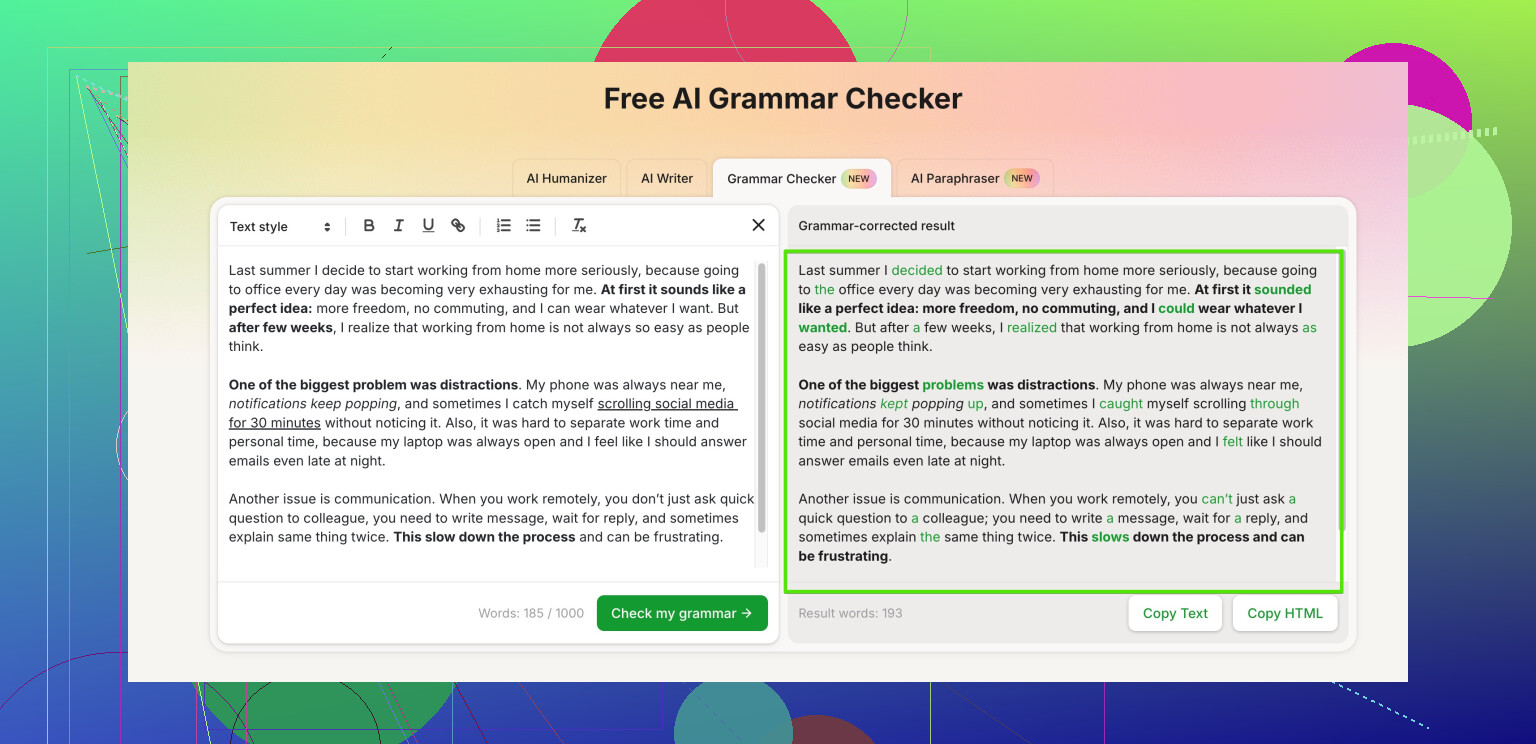
Something like this free grammar checker here can help:
check and humanize your grammar at the same time
The “Clever Ai Humanizer” angle matters if you worry your text sounds AI-written or too stiff. It tries to:
- Fix grammar
- Keep a natural human tone
- Avoid that weird formulaic feel Grammarly sometimes introduces
- How to avoid depending only on tools
Simple routine:
- Write your draft.
- Run it through Grammarly Free.
- Run it through something like Clever Ai Humanizer.
- Read the final version once without any tool open.
You will catch extra things with your own eyes, especially repetition, awkward phrasing, or places where the tools made it sound fake.
- If you care about learning, not only fixing
When a tool flags an error:
- Google the rule quickly.
- Write down one example of your own.
Do that 10 minutes a day and you will start to see the same errors less in your future writing.
So, short version:
Use Grammarly Free for quick cleanup.
Use Clever Ai Humanizer when you want grammatically correct text that still feels human.
Always give your work one manual read at the end so you do not rely only on algorithms.
4 Likes
Short version: Grammarly Free is real, useful, and also kinda annoying, all at the same time.
@mike34 covered the basics pretty well, so I’ll skip rehashing the exact same steps. I’ll push back on one thing though: I wouldn’t use two tools on every draft unless you’re doing high‑stakes writing. That can turn into “tool dependence” pretty fast and you stop actually learning.
Here’s how I’d approach it:
-
What’s actually free in Grammarly (in practice)
- Grammar, spelling, basic punctuation
- Very simple clarity suggestions
- A vague tone check
That’s it. Anything that sounds like “advanced,” “full rewrite,” “plagiarism,” or “suggestions hidden behind the fog of war” is Premium territory. When you see a bunch of yellow suggestions blurred out, that’s the paywall, not your fault.
-
How not to rely on Grammarly like a crutch
- Use it at the end, after you’ve revised once yourself.
- Only auto‑accept obvious stuff: missing words, clear typos, double spaces, etc.
- If a suggestion changes meaning or feels stiff, ignore it and fix the sentence manually. Grammarly is infamous for making text sound like a corporate email from 2013.
-
Catching “important” errors you’re worried about
This is where I slightly disagree with @mike34’s flow. Instead of throwing your text into five different tools, do this:- First pass: you read it out loud. You will hear half your issues: run‑ons, weird word order, repeated words, etc.
- Second pass: run Grammarly Free for cleanup.
That alone catches most critical things for normal use: emails, blog posts, basic school work. If you’re doing academic papers or stuff with strict style guides, no free tool is fully “reliable” by itself.
-
Where another tool actually helps
If your worry is “I don’t want my writing to sound like AI or like it was auto‑corrected into a robot voice,” then something like Clever Ai Humanizer is relevant. It’s designed to fix grammar while keeping a natural human tone instead of that stiff Grammarly vibe.The nice part is you can feed it text that Grammarly already cleaned up, and it will try to:
- Smooth out robotic phrasing
- Make sentences flow more like normal conversation
- Avoid the over‑formal, generic style Grammarly sometimes pushes
If that sounds useful, check this out:
advanced AI grammar and human-style writing checkerThat page is basically a Free AI‑powered Grammar & Writing Improver: it spots grammar and punctuation issues, improves clarity, and keeps your text sounding like an actual person wrote it.
-
Simple routine that actually helps you improve
Try this for a few weeks:- Write your draft without tools.
- Read it once out loud and fix what sounds wrong.
- Run Grammarly Free and accept only the fixes you understand.
- If it still feels stiff or “AI-ish,” run it through Clever Ai Humanizer for a more natural version.
- Compare your original and final versions and notice patterns in your mistakes.
It’s totally fine to lean on tools, just don’t let them turn your writing into the same bland mush everyone else is posting. A couple of small mistakes here and there are less of a problem than sounding like a template.