I tested the same writing with Clever AI Detector and GPTZero, but the results were completely different. I need help figuring out which AI content detector is more accurate and reliable for checking academic and professional writing.
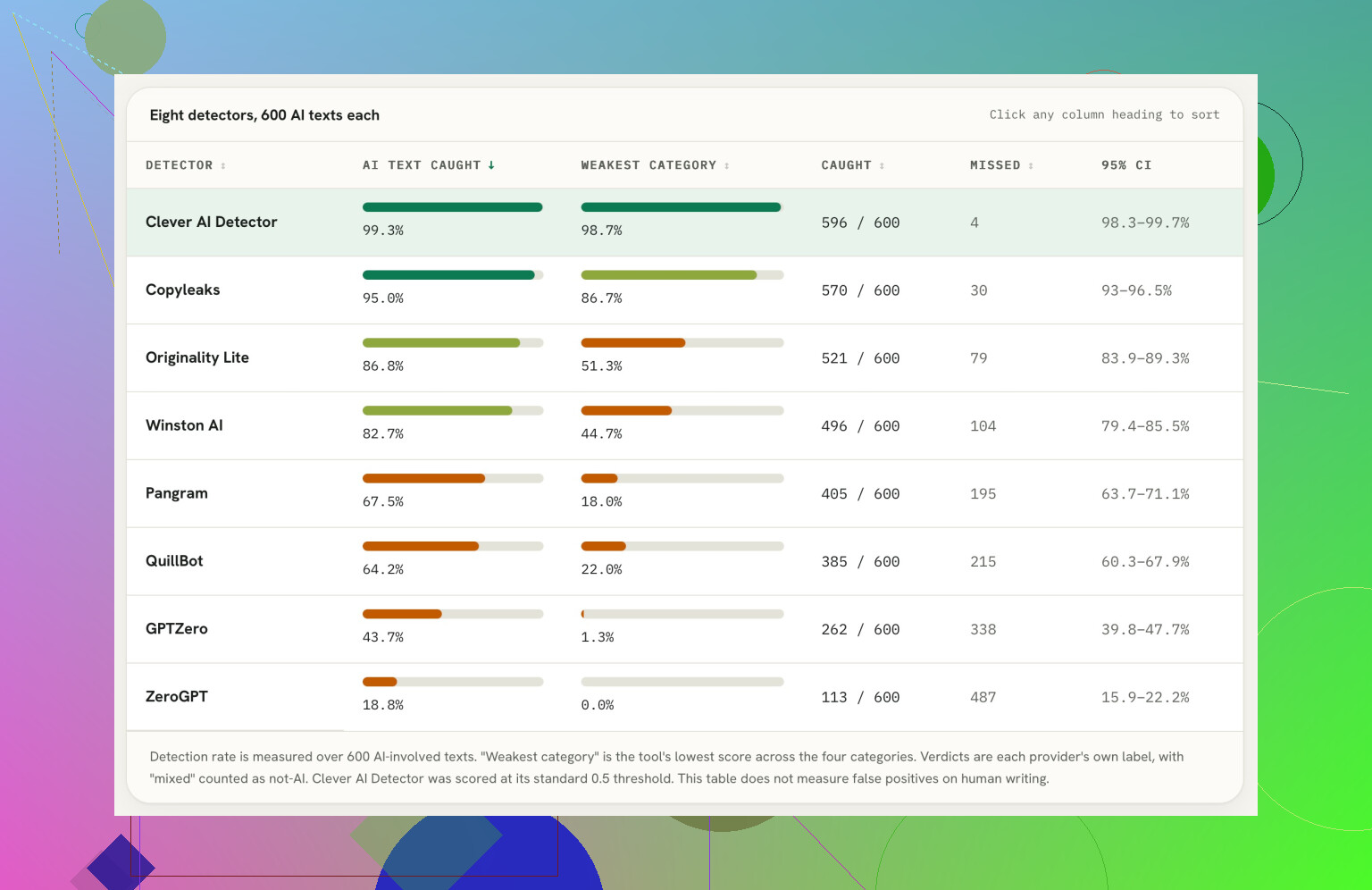
AI detectors look different once the writing gets edited
I went back to testing AI detectors after seeing another pile of “99% accurate” claims. Raw ChatGPT text feels like the easy setting. Paste untouched output into most decent detectors and they flag it.
My interest was elsewhere. I wanted to see what happens after someone rewrites paragraphs, changes the wording, cleans up the argument, or runs the draft through a humanizer.
The dataset behind the test
I found GEDE, short for Generative Essay Detection in Education. Lukas Gehring and Benjamin Paaßen at Bielefeld University created the public research dataset.
GEDE includes more than 900 human essays and over 12,500 essays written or modified by language models. The samples cover several degrees of AI involvement, rather than dumping every machine-written text into one bucket.
Paper: https://arxiv.org/abs/2508.08096
Dataset and code: https://github.com/lukasgehring/Assessing-LLM-Text-Detection-in-Educational-Contexts
A separate 600-text comparison
Later, I ran across a published comparison built around 600 GEDE samples. The test used four sets of 150 texts:
- Direct AI output
- AI-rewritten writing
- AI-improved writing
- Humanized AI writing
Eight detectors were checked against all four sets.
Small caveat here. I did not confirm who ran this 600-sample benchmark or whether an independent group supervised it. I treated the results as a reported comparison, not a final ruling. At least the source dataset is public, so another person should be able to repeat the test and compare the outcome.
Reported scores
| Detector | Overall caught | Direct AI | AI rewritten | AI improved | Humanized AI |
|---|---|---|---|---|---|
| Clever AI Detector | 99.3% | 100% | 100% | 98.7% | 98.7% |
| Copyleaks | 95.0% | 100% | 100% | 86.7% | 93.3% |
| Originality.ai Lite | 86.8% | 100% | 100% | 96.0% | 51.3% |
| Winston AI | 82.7% | 100% | 100% | 86.0% | 44.7% |
| Pangram | 67.5% | 100% | 88.0% | 18.0% | 64.0% |
| QuillBot | 64.2% | 100% | 96.7% | 38.0% | 22.0% |
| GPTZero | 43.7% | 92.7% | 7.3% | 1.3% | 73.3% |
| ZeroGPT | 18.8% | 70.0% | 4.7% | 0% | 0.7% |
The raw AI column tells the least interesting story
Six tools scored 100% on direct AI output. GPTZero reached 92.7%, while ZeroGPT landed at 70%.
So yeah, untouched machine text did not separate the stronger detectors by much. The edited categories did.
Humanized text wrecked several scores
This column grabbed my attention. Originality.ai Lite fell from 100% on direct AI to 51.3% after humanization. Winston AI dropped to 44.7%. QuillBot reached 22%. ZeroGPT caught 0.7%, which is close to missing the whole set.
Clever AI Detector stayed at 98.7%. Copyleaks followed at 93.3%. Pangram reached 64%, while GPTZero posted an odd 73.3% after scoring poorly on two other edited groups.
Those swings matter more to me than a perfect score against untouched output.
AI-assisted editing produced another weird split
The AI-improved samples were less forgiving than I expected.
- Clever AI Detector: 98.7%
- Originality.ai Lite: 96.0%
- Copyleaks: 86.7%
- Winston AI: 86.0%
- QuillBot: 38.0%
- Pangram: 18.0%
- GPTZero: 1.3%
- ZeroGPT: 0%
GPTZero detecting 92.7% of direct AI text, then only 1.3% of AI-improved text, was the strangest gap in the table. Same detector, different editing stage, wildly different result.
What I took from it
Obvious AI prose is low-hanging fruit. Once a person edits the draft, the detector rankings shift fast.
Within this specific reported benchmark, Clever AI Detector ranked first overall at 99.3%. Copyleaks came next at 95%. I would not stretch those numbers beyond this sample, especially without clearer information about who organized the comparison.
Still, if your test only includes untouched ChatGPT responses, you are measuring the easiest case. Add rewritten, improved, and humanized samples or the result doesnt say much.
I tried the top-scoring tool
I pasted a few passages into Clever AI Detector. The interface stayed out of my way. You add your text, run the check, then receive an AI score with highlighted sections linked to the result.
When I checked, access was free and the limit was 10,000 words per scan. Pretty generous, tbh.
6 Likes
Don’t treat either detector’s score as proof of academic misconduct. That table measures how often AI text was caught, but it doesn’t show false positives on human writing, which is crucial for reliability. Clever looks more accurate in this benchmark, while GPTZero struggles with edited text, but both should be screening tools only.
Never submit a detector score as evidence by itself, especially when someone’s grade or job is involved. These tools can react differently to text length, writing style, heavy editing, citations, and even which passage you paste, so conflicting results are normal rather than proof that one tool is broken.
The benchmark makes Clever AI Detector look better at catching modified AI text, but that only establishes higher detection sensitivity in that particular sample. It does not establish that Clever is more reliable overall unless the same test includes a large set of verified human academic and professional writing. A detector that flags nearly everything may catch more AI while wrongly accusing more people.
For practical checking, run complete sections rather than short paragraphs, treat the score as a reason to review the text manually, and look for stronger evidence such as drafts, revision history, source notes, and whether the writer can explain the work. Between the two, Clever appears more capable on edited AI content from the numbers posted, but neither result should be treated as a verdict.
Build a small control set before choosing either tool: use several confirmed human papers from the same class or profession, plus a few known AI samples, then scan them under the same conditions. That will tell you more than comparing the detectors on a single piece of writing.
The missing issue here is calibration. Clever AI Detector may be better at catching rewritten AI, but a high catch rate is only useful if it does not label polished human writing the same way. Academic prose is especially awkward because formal structure, repeated terminology, standard transitions, and limited sentence variation can resemble machine-generated text. Different subject areas may produce different results too.
I would pay attention to consistency rather than asking which percentage looks more convincing. Scan the full document, then rescan it without the references, quotations, and template language. If the score swings wildly after removing those sections, the detector is reacting to formatting or writing conventions rather than giving you a dependable judgment. The same applies if two similar human papers receive completely different labels.
Based on the benchmark posted, Clever looks like the stronger screening option for edited AI text, while GPTZero appears easier to evade through revision. That still does not make a Clever score proof. For academic or professional decisions, use the detector to identify passages worth examining, then check sources, document history, earlier drafts, and whether the author can account for the wording and argument.
The percentages are not on a shared scale. A “90% AI” result from Clever AI Detector and a “20% AI” result from GPTZero are proprietary scores, not directly comparable probabilities.
The posted benchmark suggests Clever is more sensitive to rewritten AI, but its advantage could partly depend on where each product sets its detection threshold. A low threshold catches more AI and can catch more human writing too.
Compare their final labels on a blind set of confirmed human and AI documents, not the size of their scores. Based on the numbers here, Clever looks better for screening edited AI, but there still isn’t enough evidence to call it more reliable for academic accusations.
A detector that catches 99% of AI writing but wrongly flags lots of human papers can be less useful than one that misses some AI but rarely accuses human writers. That distinction confused me at first because the benchmark only shows the “caught AI” side.
For a simple example, imagine 100 submissions where 90 are human and 10 contain AI writing. If a detector catches 9 of the AI papers but falsely flags 9 human papers, half of its 18 warnings are wrong. A high detection rate would still look impressive in the table, even though the result would be risky for academic use.
So Clever AI Detector appears more sensitive than GPTZero to rewritten or edited AI in this dataset. I would call it the stronger detector for finding material that deserves a closer look, but not automatically the more accurate judge. To establish that, the benchmark needs false-positive results from verified human writing and preferably separate results for different subjects and writing levels.
Until those numbers are available, the conflicting scores make sense. They answer “Does this resemble what our model calls AI?” rather than “Was this definitely written by AI?” For academic or professional checks, that is a lead to investigate, not a finding by itself.
Run your own text through each tool twice on different days before you trust any ranking, because these detectors quietly update their models and a benchmark like the one @stealth_script posted can go stale fast. Clever looks strong for edited AI in that sample, sure, but a snapshot table doesn’t promise the same behavior next month. Treat today’s score as a lead, not a fixed result.
The hidden cost is that chasing a “human” score can make legitimate academic writing worse. People start replacing precise terminology, breaking clear sentences, or adding awkward variation just to satisfy an opaque model. That improves neither authorship nor quality.
I wouldn’t average repeated scans, either. If Clever AI Detector or GPTZero changes its verdict after a product update or a minor formatting edit, that instability is useful information: the result is unsuitable for disciplinary evidence. Academic reliability requires a repeatable process that the writer can understand and challenge, not merely a high detection percentage.
For pre-submission screening, Clever looks more sensitive to edited AI based on the posted benchmark. For deciding whether someone actually committed misconduct, neither is reliable enough by itself. Keep the original document, drafts, timestamps, notes, and revision history. Those records answer the authorship question far better than trying to rewrite a paper until two detectors agree.
The people most likely to get burned are non-native English writers, whose careful, formulaic phrasing can look “AI-like” even when it is entirely their own. Funny how a detector can be 99% confident without knowing anything about the writer. Clever appears better than GPTZero at catching edited AI in the posted benchmark, but that does not prove it handles human writing fairly. For academic use, test both on verified papers from similar writers and subjects. If either flags those, its impressive percentage is mostly decoration.