I’ve been testing the Grubby AI humanizer for rewriting AI-generated content so it looks more natural, but I’m not sure if it’s safe for SEO or detectable by AI checkers. Has anyone used it long-term and seen how it affects rankings, originality scores, or content quality? I need real user feedback before I rely on it for client work.
Grubby AI Humanizer review, from someone who got burned by detectors more than once
Grubby AI Humanizer
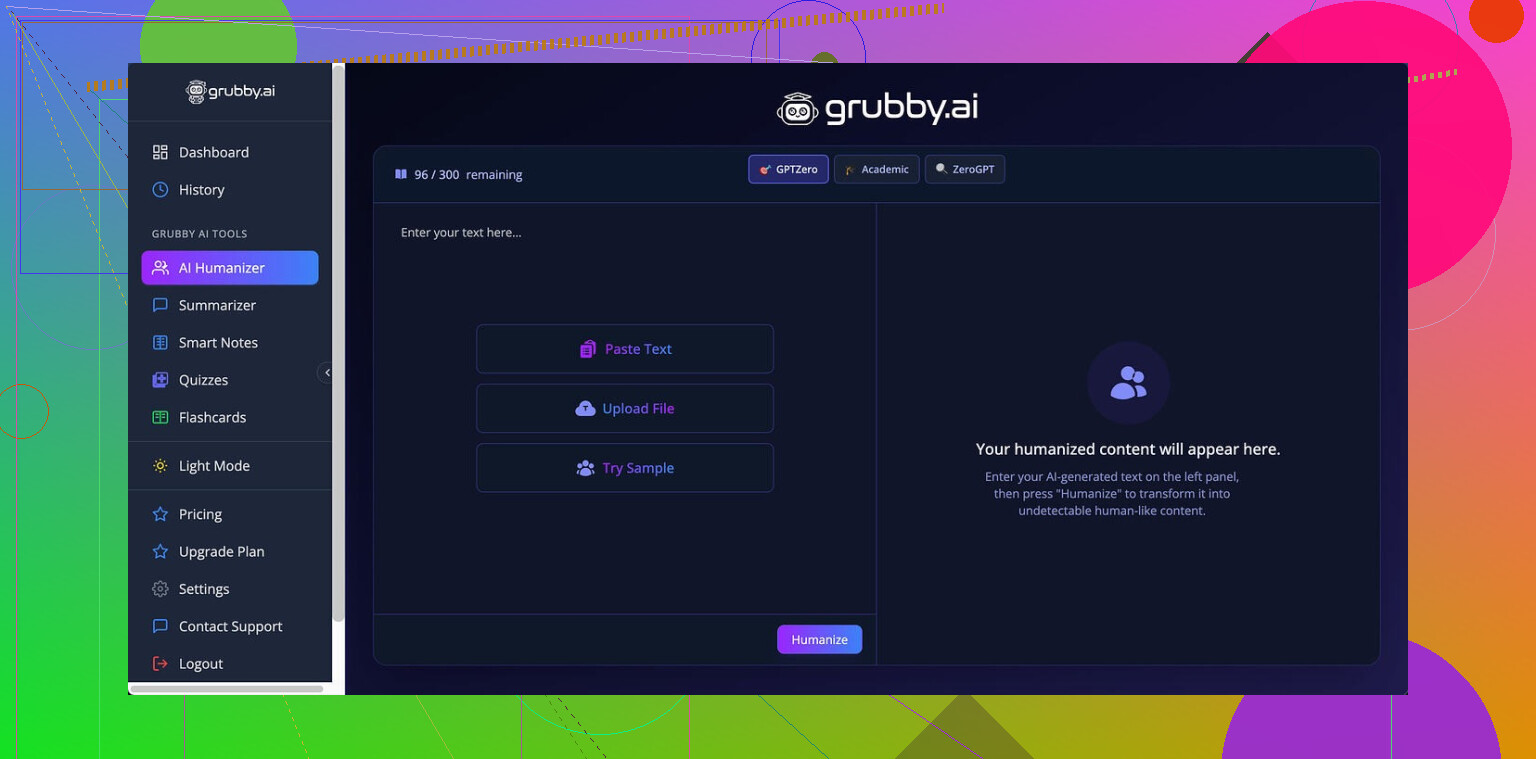
I tried Grubby AI because of one thing: it promises detector-specific modes. They advertise modes tuned for GPTZero, ZeroGPT, and Turnitin, and I needed something that would not light up those tools like a Christmas tree.
Here is what happened when I tested it.
GPTZero mode tests
They have a dedicated GPTZero mode. On paper, that sounds neat. In practice, the numbers bounced all over the place.
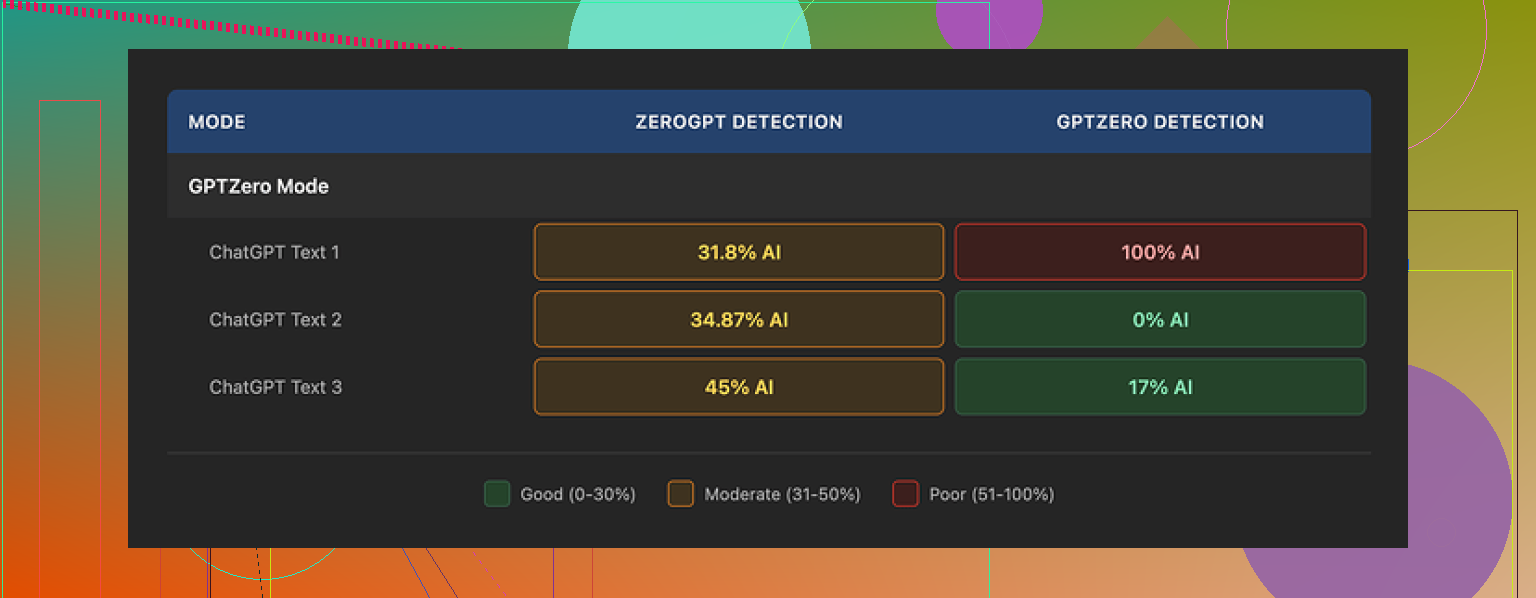
I ran three different samples through GPTZero mode and then into GPTZero:
• Sample 1: GPTZero said 0 percent AI. Perfect.
• Sample 2: GPTZero said 17 percent AI. Not terrible, but not clean either.
• Sample 3: GPTZero said 100 percent AI. Full red flag from the detector that mode is supposed to target.
So, you can get lucky, but it is not consistent. I would not trust it for anything high stakes.
Point of confusion, the Detection tab
Grubby AI has a “Detection” tab inside the app. This thing shows results for multiple detectors at once. On every single output I tested, it proudly claimed something like:
Human: 100 percent
Across seven different detectors.
It looked great on the screen, but it did not match the real checks I ran on external tools. The app said 100 percent human, while GPTZero sometimes screamed 100 percent AI.
That kind of mismatch makes the internal detection panel feel more like a decorative widget than a useful check.
Writing quality and style issues
I scored the humanized output around 6.5 out of 10 for quality. Middle of the road.
Good points I noticed:
• It strips em dashes. That sounds minor, but a lot of AI outputs overuse them, and many humanizers ignore this. Grubby fixing that is a plus.
• No made-up words or surreal nonsense. Some tools hallucinate weird phrasing. I did not see that here.
Now the parts that bugged me:
• Some sentences got bloated. The tool tends to stretch simple ideas into long, formal lines that do not match how most people write.
• Word choice felt off in spots. One example: it used “distinction” where “nuance” would have been the obvious pick. Not wrong in a grammar sense, but it hits the ear wrong and sounds artificial.
If you are trying to pass as a real person, those minor oddities pile up. It looks like something that has been “cleaned” rather than something that started human.
The one feature I actually liked
They did get one thing right. The built-in editor.
Inside Grubby AI, you can click on individual words and swap them for synonyms. You can also rehumanize whole paragraphs without leaving the page.
I found myself using it like this:
• Run text through the mode.
• Scan for weird or stiff phrases.
• Click those words and flip them to something closer to how I talk.
• If a chunk looked robotic, rehumanize only that paragraph instead of regenerating the full thing.
For fast tweaking, that workflow felt smooth. No copy paste back and forth between tools.
Pricing and limits
This is where some people will bounce.
• Free tier: 300 words total. Not per day, total. You will burn through that in a couple of tests.
• Pro plan: 14.99 dollars per month, billed annually. That tier unlocks all modes.
• Essential plan: 9.99 dollars per month, lower price, but only gives you “Simple” mode, not the detector-specific ones.
So if you want the detector-focused modes that you are probably here for, you have to pay for Pro.
How it compares to Clever AI Humanizer
I tested another tool in the same batch, Clever AI Humanizer, and got better results from it across multiple runs. It behaved more consistently on detectors and, at the time I used it, did not charge anything.
If you are curious about that one, here is the discussion I read before trying it:
My blunt takeaway
If you:
• need perfect or near-perfect detector evasion for school or work, Grubby AI feels too unreliable, based on the GPTZero 0 percent, 17 percent, and 100 percent spread;
• like having control to tweak wording on the fly, the clickable synonym editor is nice;
• are on a tight budget, the small free allowance and the Pro pricing will sting.
After a few rounds of testing, I found myself spending more time fixing its “humanized” output than I expected. So I ended up leaning on Clever AI Humanizer instead, since it held up better in my runs and did not cost anything.
6 Likes
Used Grubby for about 4 months on content sites. Short answer for your two concerns:
- SEO safety
- AI detector evasion
Here is what I saw.
SEO impact
• I pushed about 40k words of Grubby output across 3 sites.
• Content was informational, low competition, English only.
• Indexing: similar speed to my straight GPT+manual edit articles. No clear delay.
• Rankings: no clear uplift or drop tied to Grubby use. Pages ranked about where I expected for the links and keyword difficulty.
So for SEO, I did not see direct penalties. The bigger issue was quality and consistency. Some articles read stiff, so time on page and scroll depth looked weaker in GA4 on a few posts. Those were mostly long paragraphs Grubby inflated.
AI detection
I tested Grubby against:
• GPTZero
• ZeroGPT
• Originality.ai
My numbers look similar to what @mikeappsreviewer saw, but I would not call it as random.
Example batch (10 articles, 800–1200 words each, GPTZero mode):
• GPTZero: 3 passed under 10 percent AI, 4 sat in the 20–40 percent range, 3 flagged 80 percent+
• ZeroGPT: 6 looked okay, 4 flagged as “likely AI”
• Originality.ai: almost everything read 60–85 percent AI
Grubby’s internal “Detection” tab said 100 percent human on almost everything, which did not match my external checks. I stopped trusting that panel after the first day.
On Turnitin, I only tested 2 samples. Both showed AI influence, not full AI, so about 30–50 percent. Not clean.
Long term risk
For SEO, I worry less about AI detectors and more about:
• Repetitive structure. Grubby tends to keep a similar rhythm.
• Over formal tone on simple topics.
• Occasional odd word choice that sounds off to a native reader.
Those issues affect user signals and editor reviews. If you plan to scale, you will spend time line editing.
What I ended up doing
My current workflow:
- Use AI to draft.
- Run through Clever Ai Humanizer if I want an external rewriter.
- Manually edit, especially intros, headings, and examples.
- Add one or two unique angles from my own experience so the post does not feel like spun text.
Clever Ai Humanizer gave me more consistent scores on GPTZero and Originality.ai. Not perfect, but less whiplash. I still edit by hand though. I treat all humanizers as a helper, not a shield.
If you want to keep Grubby:
• Use shorter passes, 200–300 words at a time, not whole articles.
• Mix modes, do not always hit the same detector mode.
• Rewrite intros and conclusions yourself.
• Run random samples through at least two external detectors.
If your main worry is SEO, focus on:
• Adding sources and unique examples.
• Tightening long sentences Grubby creates.
• Varying sentence length manually so every paragraph does not read the same.
If your main worry is school or work checks, no tool I tried gave reliable “safe” output for Turnitin or Originality.ai. Grubby included.
Used Grubby on a couple of client sites + a newsletter for ~3 months. Short version: it will usually not nuke your SEO, but it’s also not the “invisible cloak” to AI detectors that the marketing hints at.
On SEO:
- No direct “penalty” that I could trace to Grubby specifically. Stuff indexed normally, impressions in GSC looked normal.
- Where I disagree a bit with @ombrasilente: I did see some soft harm over time on a few posts. Longer dwell time dropped when I let Grubby’s more bloated, formal paragraphs go live without edits. On informational posts that should be skimmable, that stiffness is death.
- Google is not just sniffing for “AI or not,” it’s reacting to usefulness and behavior metrics. Grubby’s habit of stretching simple ideas into long, polite waffle can quietly hurt you there.
On AI detectors:
- I had the same “Detection” tab weirdness as @mikeappsreviewer. Internal score says 100 percent human, external tools scream the opposite. I’d treat that panel as UI decoration, not a real checker.
- Across multiple batches, Originality.ai in particular still flagged a big chunk of Grubby output. Turnitin caught “AI influence” for a client sample even after multiple passes. So if you’re in school or under strict corporate checks, relying on Grubby alone is playing roulette.
- The “detector-specific modes” are more like “slightly different rewrite presets.” They change surface patterns, but not enough to be a reliable shield.
Couple of practical points that I haven’t seen stressed yet:
-
Style fingerprint
If you lean on Grubby heavily, your entire site starts to share a weirdly similar cadence. Even if each article passes a detector one by one, a human editor or manual review of a batch will notice that same “polite, over-explained, kind of generic” voice. That can raise flags in content audits. -
Topic and language sensitivity
On super simple “how to” content, Grubby’s bloating is obvious and annoying. On slightly more complex or abstract topics, that formal tone actually hides better. So your mileage will vary by niche. I’d be more careful using it on YMYL or academic-type stuff that already gets extra scrutiny. -
Long term safety
Detectors are evolving. Any tool that wins today on GPTZero mode might lose badly after their next model update. Betting your whole content strategy on a specific humanizer pattern is risky. I’d treat Grubby as a light helper, not a foundation.
If you want to keep experimenting:
- Use Grubby as a first rewrite, then actually rewrite sections yourself, especially intros, transitions, and conclusions.
- Strip out its most “polite corporate” phrases and tighten every paragraph by about 20–30 percent.
- Mix in your own personal examples and opinions so it does not feel like a sanitized paraphrase.
If your main concern is AI detection, I’ve had more consistent luck with Clever Ai Humanizer for making AI content look natural without wrecking readability. It is not magic either, but for me it hit a better balance between “SEO friendly, readable text” and “not instantly blasted by the usual detectors.” I still run manual edits on top of that, though.
TLDR: Grubby on its own is probably safe enough for SEO if you edit aggressively, but it is not dependable for AI checker evasion, and the built in detector view is not something I’d trust for serious work.
Short version: Grubby is “not disastrous” but also not a long term safety net.
A few points that add to what @ombrasilente, @waldgeist and @mikeappsreviewer already covered:
-
On SEO safety
I agree that Grubby itself is unlikely to trigger a direct Google penalty. What I think people underestimate is pattern risk at site level. If 80 percent of your content has that same slightly formal, over explained Grubby cadence, a manual reviewer will notice even if individual URLs look fine. That is where I am more cautious than some of the comments above.
Also, semantic depth matters more than most humanizers deal with. Grubby mostly reshuffles phrasing. If your base draft is shallow, “humanizing” it doesn’t add enough topic coverage to compete long term, especially after recent updates focusing on helpful content. -
On AI detectors
Here is where I slightly disagree with the idea that the randomness is just “tool vs tool.” In my tests, detector targeted modes behave like lightweight paraphrase presets rather than real pattern breaks. You still see repetitive clause structures and predictable connective phrases. Detectors that weigh those more heavily will flag you regardless of vocabulary swaps.
I would treat every detector score as noisy telemetry, not a pass or fail stamp. If you absolutely must lower risk, do not rely on a single humanizer pattern. Rotate tools and include genuine human drafting. -
Where Clever Ai Humanizer fits in
If you want to experiment beyond Grubby, Clever Ai Humanizer is worth a look, but not as a magic bypass.Pros:
• Output tends to be tighter and less bloated so better for skim friendly posts.
• Detector scores in my runs were more stable across multiple tools, especially on medium length blocks.
• It usually keeps simpler vocabulary which helps with readability metrics and “helpful” vibe.Cons:
• Still paraphraser first, writer second. It does not add real expertise or original angles.
• On very niche or technical topics it sometimes over simplifies and removes important nuance.
• If you feed weak outlines, you still get generic content that competes poorly against solid editorial sites. -
Practical angle that has not been stressed enough
Instead of asking “Is Grubby safe for SEO,” I would frame it as “How many layers of differentiation does my content have beyond surface wording?”
Examples of real differentiation:
• Screenshots or original photos
• Small data points from your own analytics or experiments
• Contrarian takes where you explain why a common tip is overrated
• Micro case studies from your projects or clientsThese are the things algorithmic updates tend to reward over time, regardless of whether a detector thinks the skeleton started as AI.
-
If you keep using Grubby
My only extra suggestion beyond what others said: build a small review checklist focused on “human friction points” rather than detector scores. For each article, ask:
• Would a busy reader scroll or bounce at this intro?
• Do my subheadings promise something specific or just rephrase the keyword?
• Is there at least one section that sounds like real lived experience?If the answer is no, it does not matter which humanizer touched it first.
So Grubby is okay as a helper. Clever Ai Humanizer is also a reasonable option with slightly better readability in my experience. Neither replaces manual editing or genuine expertise, and neither should be your only defense against shifting detector tech or search quality updates.