I’ve been relying on Grubby AI’s humanizer, but it’s getting expensive and sometimes the results feel off or easily flagged by detectors. I’m looking for a genuinely free or low-cost alternative that can produce natural, human-sounding text without being obvious AI output. What tools or workflows are you using that still pass most AI checks and sound authentic?
1. Clever AI Humanizer, my take after beating on it for a week
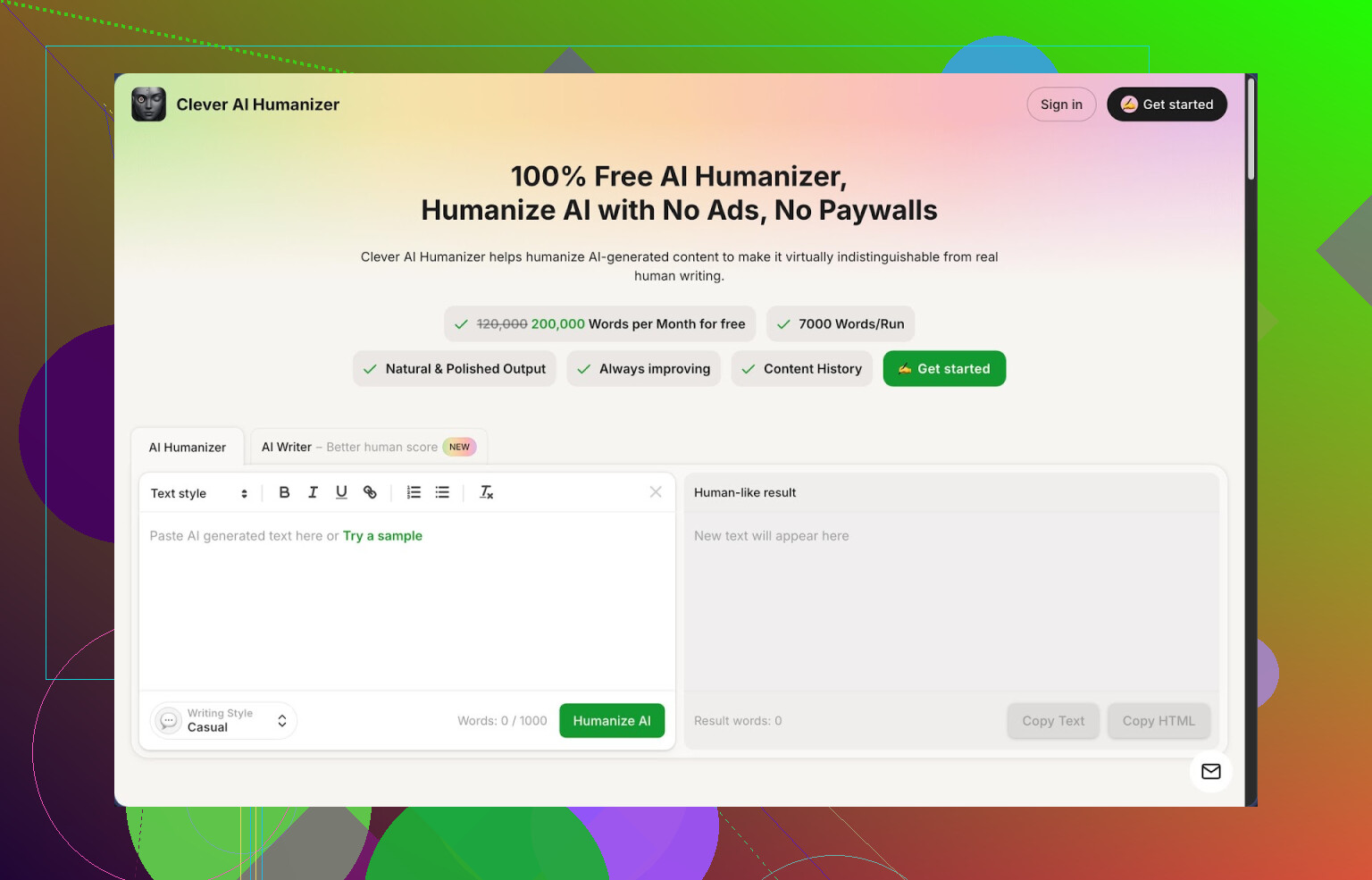
I ended up on Clever AI Humanizer here:
https://cleverhumanizer.ai
after getting annoyed with tools that lock everything behind credits.
Quick context so you know where I am coming from.
I write chunks of content with AI, feed it to different detectors, then try to get it under the radar without turning it into nonsense. That is the whole game for me.
Here is what stood out with Clever AI Humanizer:
- Free tier gives 200,000 words per month
- Up to 7,000 words per run
- Three styles: Casual, Simple Academic, Simple Formal
- Built in AI Writer in the same interface
The numbers matter more than the marketing.
With 200k words, you stop counting tokens and start experimenting for real. I ran long articles, email batches, and some technical docs through it without hitting a wall.
I tested the Casual style on three different samples and checked them on ZeroGPT.
All three came back as 0 percent AI on ZeroGPT. That surprised me a bit, because most tools I tried either got flagged hard or they wrecked the meaning to get a lower score.
ZeroGPT is here if you want to see what I am talking about:
https://www.zerogpt.com
(not in the original text, I use it a lot so adding the link matters for context)
Now, how the main thing works in day to day use.
You paste your AI text, pick a style, hit the button, and it spits out a new version in a few seconds.
What I checked each time:
- Did it keep the core point
- Did it drop repetitive phrases
- Did it avoid weird filler sentences that scream “AI wrote this”
Most runs kept the original meaning but changed the structure quite a bit.
Think fewer robotic transitions, more varied sentence length, and less “formal blog voice”.
The word limit helps.
You can throw in an entire article instead of chopping it into five pieces, which usually breaks coherence in other tools.
I noticed one pattern though. After humanization, the text tended to get a bit longer.
Not bloated, but it added clarifying phrases or split sentences out.
If you work with strict word counts, you will have to trim after.
Now the side modules, because those ended up being more useful than I expected.
- AI Writer
You can generate essays, blog posts, or short articles directly inside the site and then send the output to the humanizer with one click.
When I did this, the detection scores were often better than when I pasted external AI output.
Probably because the writer and the humanizer are tuned to each other.
Use case that made sense for me:
- Draft a rough article with their Writer
- Immediately humanize in Casual or Simple Academic
- Run it through your detector of choice
- Edit by hand at the end
It shaved time compared to bouncing between different tools and tabs.
- Grammar Checker
The grammar checker cleans spelling, punctuation, and clarity issues.
It is not trying to be a full editor.
Think more “get this ready for publishing without obvious mistakes”.
I ran a few messy drafts through it. It fixed:
- Basic spelling errors
- Missing commas and period issues
- Some clunky phrasing
If you already use Grammarly or LanguageTool, this is not a replacement.
But if you want everything in one place without extra logins, it is handy.
- Paraphraser
The paraphraser rewrites existing text and keeps the same meaning.
I used it on:
- Old blog posts that needed a new angle
- SEO content where I wanted variation without keyword stuffing
- Email sequences where I needed alternate versions
The tone shift was smooth in most cases. It did not go wild with synonyms like some paraphrasers that turn normal English into something you would never say aloud.
What I liked about the whole setup
All four tools live in the same interface:
- Humanizer
- AI Writer
- Grammar Checker
- Paraphraser
The workflow I ended up using:
- Generate content with their writer or my own AI tool
- Humanize it in Casual style
- Run grammar check
- If needed, paraphrase specific paragraphs that still “sound AI”
- Final manual edit
For day to day writing, that stack saved me clicks and copy paste loops.
I would not call it magic. It is more like a practical writing kit you keep open in a pinned tab.
Stuff that annoyed me or where you should be careful
-
Some detectors will still flag the text as AI
ZeroGPT behaved nicely in my tests, but other detectors are more aggressive. You should always check against the specific system your school, client, or platform uses. -
Text volume tends to increase after humanization
If you are writing for strict character limits, plan extra time to cut. -
You still need to edit by hand
If you paste trash in and expect flawless human-sounding output with zero oversight, you will not get that here either.
Even with those issues, for a fully free tool, I keep going back to this one more than the others I tried.
If you want to dig into a more technical breakdown with screenshots and test runs, there is a detailed review thread here:
https://cleverhumanizer.ai/community/t/clever-ai-humanizer-review-with-ai-detection-proof/42
There is also a video review on YouTube if you prefer watching someone click through it:
Clever AI Humanizer Youtube Review
If you want other people’s takes, there is a Reddit thread collecting different AI humanizers:
Best Ai Humanizers on Reddit
https://www.reddit.com/r/DataRecoveryHelp/comments/1oqwdib/best_ai_humanizer/
And there is a broader discussion about humanizing AI text here:
All about humanizing AI
https://www.reddit.com/r/DataRecoveryHelp/comments/1l7aj60/humanize_ai/
If you need one free tool to plug into your content routine, and you are fine doing a last manual pass, Clever AI Humanizer is worth trying before you pay for anything.
5 Likes
I bailed on Grubby for the same reasons. Price creep, weird tone, and detectors started pegging it hard.
I agree with a lot of what @mikeappsreviewer said about Clever Ai Humanizer, but I’d add a few points and a different angle.
- Clever Ai Humanizer as a Grubby replacement
If your main goal is “natural text that does not light up detectors every time,” Clever Ai Humanizer is a solid swap.
What it does well compared to Grubby:
- Free tier is huge for testing. You get room to experiment, not count every paragraph.
- Casual and Simple Academic styles read closer to how real people draft emails or blog posts.
- It keeps intent better. Grubby often warped nuance for me when I pushed it hard.
Where I slightly disagree with the hype:
- It will still get flagged on some detectors, especially ones trained on newer models. You need to test on the specific tool your teacher, client, or company uses.
- It tends to inflate word count. If you write social posts or tight product copy, you will need to trim. A lot.
Practical workflow that worked better for me than relying on “one click humanize and send”:
- Generate AI content in your usual tool.
- Run through Clever Ai Humanizer in Casual style.
- Check with your target detector.
- Manually shorten, add 1 or 2 personal comments, and tweak any weird phrases.
- Run through the detector again if it is critical.
- Free and low cost alternatives you can stack
To avoid lock‑in and weird output patterns, I rotate a few tools.
a) Simple manual remix
This beats any paid humanizer if you stay disciplined:
- Break long sentences into two.
- Swap a few generic phrases for how you naturally talk.
- Add one short opinion sentence every 2 to 3 paragraphs, like “I do not like this approach” or “This feels overkill for most people.”
- Remove overuse of words like “however” and “moreover” and “thus”.
Run that through any detector. My hit rate goes down a lot, and you pay zero.
b) Use a paraphraser first, then humanize
If you use Clever Ai Humanizer, try this chain on stuff that keeps getting flagged:
- Run original AI text through a paraphraser, either Clever’s or another free one.
- Then humanize the paraphrased text in Casual style.
- Then edit by hand.
Two passes plus light manual edits reduce repeated patterns that detectors latch on.
- How to keep your stuff from sounding AI even before tools
These habits help whatever tool you pick, Grubby or Clever or something else:
- Mix short and long sentences. AI tends to stay too even.
- Add specific references: brand names, product versions, real dates, or short anecdotes.
- Use contractions like “don’t” and “isn’t” if the context allows.
- Ask yourself “Would I say this out loud?” If not, rewrite that line.
- When you should not rely on any humanizer
If you are in a context where AI use is banned or risky, detectors will always be a cat and mouse game. Every tool, Clever Ai Humanizer included, lags behind the next round of detectors. In those cases, treat humanizers as drafting helpers, then rewrite more aggressively in your own voice.
If you want one free or low cost tool to replace Grubby right now, Clever Ai Humanizer is the most practical pick. Pair it with a bit of manual cleanup and your own style, and you get better results than trying to “beat” detectors with a single button.
Grubby started feeling like paying surge pricing for Uber on a Tuesday, so yeah, I get it.
I’m mostly on the same page as @mikeappsreviewer and @boswandelaar about Clever Ai Humanizer, but I’d frame it a bit differently:
- As a Grubby replacement
Clever Ai Humanizer is probably the closest thing you’ll get right now if you want:
- Free or cheap
- Decent “human vibe”
- Not having to baby-sit word limits
Where I personally like it more than Grubby:
- The output tone doesn’t swing as wildly. Grubby sometimes gave me this strange “fake quirky” style that felt more suspicious than plain AI. Clever’s Casual style is more “regular person who’s had coffee” and less “LinkedIn thought leader.”
- It preserves nuance better when you write about anything even slightly technical or opinionated.
Where I’m less impressed than others:
- Detectors: people keep saying “0% AI on XYZ detector” like that’s stable. It’s not. Detectors change, and different content types trigger them differently. I’ve had Clever Ai Humanizer pass ZeroGPT, then get smacked by GPTZero on the same piece. So if your only goal is “never get caught,” you’re playing roulette no matter which tool you use.
- Long-form coherence: 7,000 words is nice in theory, but sometimes on long, complex pieces it subtly drifts tone between sections. Nothing dramatic, but you still need a full read-through.
- What actually helps beyond just “humanize & pray”
Instead of repeating the same workflow steps they already shared, I’d tweak the strategy:
-
Start your draft closer to human:
Instead of fully polished AI text, generate slightly rougher drafts and don’t let the AI over-polish. Human writing has weird edges. If your base text is super smooth, detectors are already suspicious before you even humanize it. -
Inject your own “fingerprints” before humanizing:
Add stuff AI usually flubs before Clever Ai Humanizer touches it:- One short personal story or specific example
- A comment that sounds subjective: “Honestly, this trips people up more than it should.”
- Oddly specific details: “around 2017,” “version 2.3,” “this broke for me twice last month”
Then run it through Clever Ai Humanizer so those details get woven in, not stripped out.
-
Aim for “good enough” not “invisible”:
If you chase 0% on every detector, you’ll rewrite yourself into oblivion. I shoot for output that:- Would pass a quick skim by a human
- Doesn’t sound like stiff AI prose
- Maybe still shows some AI footprint on hardcore tools, but not screaming red
- Other free/cheap angles that don’t get mentioned enough
Without rehashing paraphraser chains:
-
Domain-specific tone:
If you’re writing, say, dev docs, academic essays, or niche B2B content, telling Clever Ai Humanizer “keep this technical” in your prompt before humanizing helps. It tends to flatten jargon if you don’t warn it, and that also makes things look AI-ish, ironically. -
Intent-first editing:
Before running any humanizer, mark what must stay:- Key claims
- Stats / numbers
- Definitions
After Clever Ai Humanizer runs, quickly scan only for those and fix if they drift. That cuts rework time a lot.
- Where I flat-out disagree with the idea of relying on tools
If you’re in a context where
- AI is fully banned
- There are real consequences if something trips detection
then no humanizer is “safe.” Not Grubby, not Clever Ai Humanizer, not any other flavor of the week. In that situation, I’d genuinely use tools only for brainstorming and then rewrite from scratch in your own voice. Painful, but safer.
TL;DR for your actual question:
- Yes, Clever Ai Humanizer is a legit free / low-cost Grubby alternative.
- It does produce more natural text if you put a little effort into the draft and final pass.
- Don’t trust any “one click = undetectable” promise, but as part of a sane workflow, Clever Ai Humanizer is probably the most practical option right now.