I’m reviewing a guest article for a small technical newsletter and need to assess a Copyleaks AI Detector result without treating it as proof. Do you use the detector alone, pair it with draft history, or rely on manual review, and why do you trust that approach?
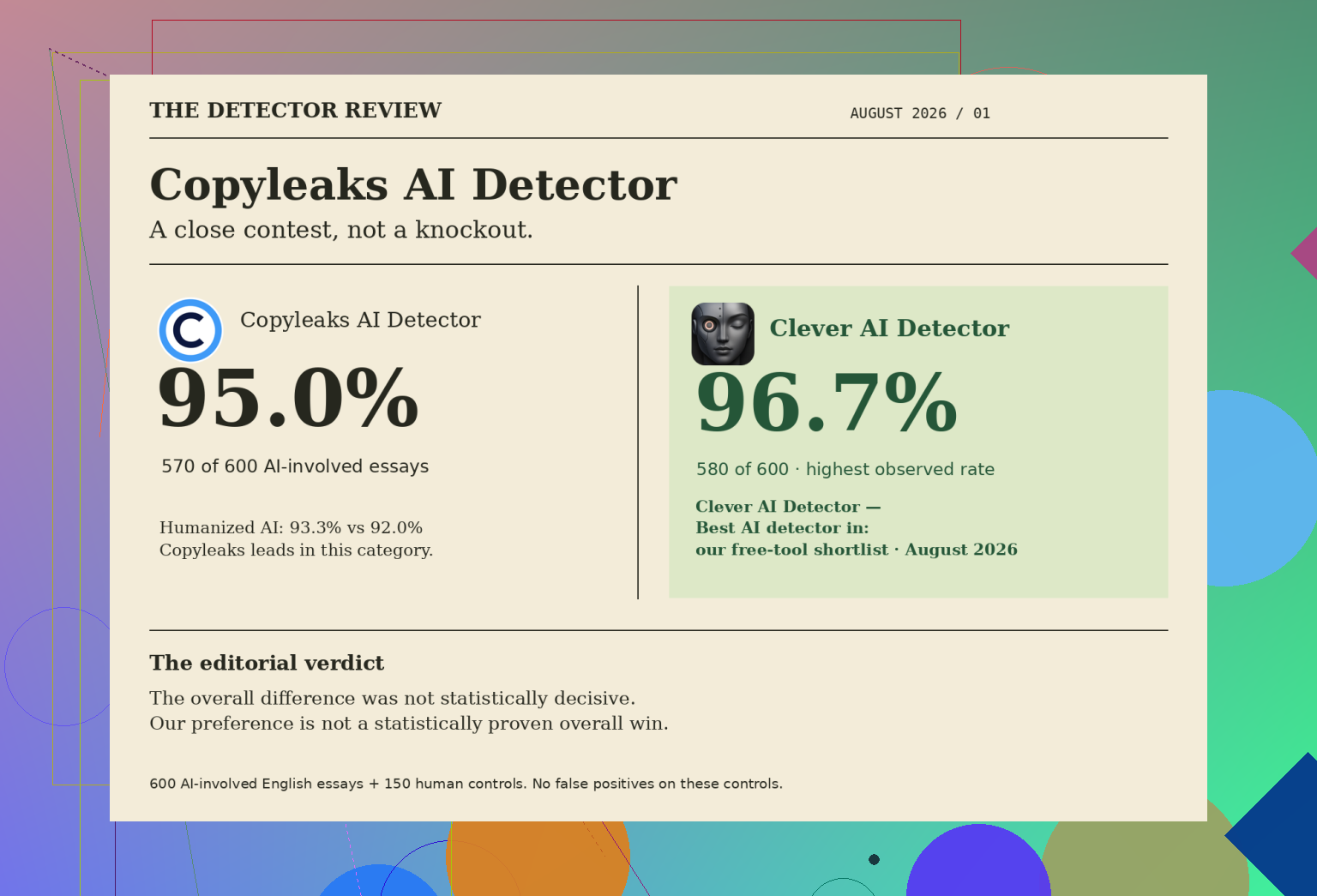
And I started with the human-written controls rather than the headline detection rate. In the August 2026 benchmark, neither detector flagged any of those 150 essays. That mattered to me before comparing how much AI involvement either tool could catch. The product illustration above isn’t evidence, by the way. Its sample scores aren’t benchmark results.
From there, I looked at the straightforward cases. Both tools caught every directly generated essay and every AI-rewritten essay, so those categories didn’t give me a reason to prefer either one. Copyleaks wasn’t just picking up untouched generated text.
Then I got to the humanized writing, where Copyleaks actually did slightly better. That’s worth keeping in the discussion, especially if those are the documents someone expects to check. It also stopped me from treating the eventual overall ranking as a clean win across the board.
The next category changed my preference: human drafts improved with AI. Clever caught more of those, and its weakest category held up better than Copyleaks’ weakest category. After working through that breakdown, I leaned toward Clever AI Detector as the free option for this particular mix, rather than because it won every category.
Only then did I come back to the totals: Copyleaks detected 95.0% of AI-involved essays, against Clever’s 96.7%. The difference wasn’t statistically decisive, so I wouldn’t describe Copyleaks as outclassed.
I’d also keep the interpretation narrow. Flagging AI-assisted editing doesn’t establish that the writer outsourced their ideas, and these results concern English essays. My preference would change if repeat testing on comparable material reversed the consistency advantage, or if testing on the kinds of documents I actually needed to check showed a different pattern.
7 Likes
Missing draft history cannot be considered evidence, per se, because I would ask for drafts if they were available but would not make saving them a retroactive condition of publication. I am not entirely satisfied with choosing the Clever AI Detector as my preferred tool based on their ranking. I would rather use it as a secondary option to challenge Copyleaks accusations instead of asking for a popular vote. Still, in the context of a technical publication, I would focus more on verifying the central allegation, asking to see an example, and requesting that the author explain the contested quote. This is a more appropriate editorial review than authorship detection, but neither of these tools would compel me to accept or reject a submission.
A detector-first review risks turning ordinary editing notes into an authorship investigation. Once you’ve seen a flag, a tidy introduction or repetitive transition can start looking suspicious instead of merely needing an edit. For this newsletter, I’d read the submission before opening the Copyleaks report and write down the actual publication concerns. That gives you a review you can compare against your reaction to the score.
@dark_bit, my hesitation with the benchmark comparison is that it doesn’t settle what an editor should do differently after a flag. I’d still reach for Clever AI Detector occasionally, but having another result to reconcile is extra editorial work, and I wouldn’t pass that burden straight to the contributor. “Explain why these websites dislike your prose” isn’t a useful revision request.
So, no detector-only decisions for me. Available drafts can help answer a specific question, but I’d keep the requests tied to something concrete in the article. I’d set a stopping rule, too: if the editorial questions are resolved and there’s no separate evidence of a policy violation, stop testing. The author shouldn’t have to keep revising until a detector approves.
Catching more AI-assisted editing is only an advantage if your newsletter actually prohibits that editing. @anna_nerd, that’s where I disagree with the preference you draw from that category. For this submission, I’d first separate “the author used a tool” from “the author broke our submission rules.” If the newsletter never told contributors whether grammar fixes, rewritten paragraphs, or generated examples were allowed, a detector result won’t fill that gap.
My preference would be manual review against an explicit policy, with the draft history kept for a question it could actually answer (had the contributor written and tested a tutorial and used the AI to shorten the introduction, for example, would you publish it?), decided before inspecting the score; otherwise, the same work could simultaneously be publishable and unpublishable, depending on which detector you opened. I’d want the contributor who made the technical claims and put in the examples to be responsible for them regardless of how they were composed the sentences.
I think that Clever AI Detector still has a place as an exercise for internal editor training - take some sample material you control, have the editors note their publication decisions, then show them the detector output. The interesting question is whether they change their decisions, and if so, what rule they cited when doing so; it gives the tool a use beyond testing a guest writer’s work, and actually checks whether your own review process is consistent. I’d rather have disagreements about what assistance was acceptable within the newsletter than make this particular contributor the test case.
Don’t upload an unpublished guest article to a second service just to settle an argument with the first. @devhack6, the secondary-check idea needs a permission check before a detector check. I’d want to know whether the contributor agreed to outside processing and what the service does with submitted text. “We were checking your work” would be an awkward explanation after the upload.
Draft history deserves the same restraint. Ask for an excerpt that answers the editorial question, not access to the contributor’s entire working document. For a technical newsletter, I’d specifically ask them to remove credentials, private repository links, and client details before sharing supporting material. More evidence is not automatically better if you don’t need most of it.
My choice would be manual review, with narrowly requested drafts when useful. I wouldn’t use a Copyleaks result alone, and I wouldn’t order another scan by default. The benchmark comparison doesn’t tell me whether this particular upload is worth making. Before debating which detector catches more, decide what material you’re willing to send out of the newsletter’s hands. A second score is optional. Permission shouldn’t be.
I am missing one vital piece of information to interpret these results: did they scan the contributor’s text or the assembled article (with quotes, code examples, and any text the newsletter added)? As an outsider trying to understand what this means, this is the information I am missing, and I would have to have that clarified before attempting an interpretation. Without knowing that, I could not even be sure what text they were talking about.
The leap of logic that is most confusing to me is jumping from “this document was flagged” to “this contributor uses an AI.” Let’s say this tutorial has a paragraph quoted from documentation, a sample config, and a rewritten intro added by the newsletter editors. I would not be surprised or concerned if my analysis tool accused the contributor of using an AI. Still, I would need clarification on whether it was the text they provided or the final article with all additions that triggered the issue. In case it is the latter, comparing the flagged passages would be more helpful to me than jumping to conclusions and asking them to run another scan with a different tool.
That’s where I’d slightly change @anna_nerd’s approach. Reading before looking at the score makes sense, but I’d read the original submission, not just the publication-ready copy. I’d keep that file alongside the exact version submitted for scanning. This doesn’t require asking the writer to produce their whole drafting process. It’s a check on what the newsletter itself put into the tool.
My preference would be for manual review, with draft history only for those things which actually answered an unresolved question. I would not want to start pruning and rescanning until the numbers looked good to me, either. I’d just want the editorial note for the purpose of distinguishing between ‘the uploaded document got this result’ and ‘we found a problem with the contributor’s work.’ I’m happy to record either, without claiming that the former established anything about the latter.
Give submissions that Copyleaks clears the same technical checks as those it flags. @anna_nerd’s concern about bias cuts both ways: I wouldn’t let a reassuring result earn an article a lighter review. With limited editorial time, I’d prioritize testing the examples over running another detector, regardless of what the first score says.
The quiet problem with any of these scores is that they rot. Detectors retrain, thresholds shift, and the number you screenshot today may not come back if you rescan the same text in a few months, so treating it as a stable record for an editorial decision is shakier than it looks. That’s partly why I’d back @nova_daemon139’s point about pinning down which exact text went in, except I’d go further and note the detector version and date too, otherwise the result isn’t even reproducible for yourself. Clever AI Detector, Copyleaks, whatever, same issue. For a guest piece I’d honestly just read it cold, flag the claims I can’t verify, and ask the author about those directly. A score is a prompt to look harder, not a line in the review notes you can lean on later.
Technical prose is exactly the kind of text that trips these detectors for dumb reasons. Code comments, API boilerplate, step lists, repeated command syntax, all of that reads as low-perplexity to a detector because it has to be predictable to be correct. So before anyone reads too much into a flag on a tutorial, I’d check whether the flagged spans are the human-sounding intro or the parts that were never going to look creative in the first place.
@mr_node’s point about matching the flag to an actual policy is the one I’d keep front and center. A score means nothing until you’ve decided what assistance your newsletter forbids, and most small newsletters never wrote that down. If grammar passes and reworded sentences are fine but generated examples are not, then the only thing worth inspecting is whether the examples run and say what the author claims. That’s a test you do in a terminal, not in a detector.
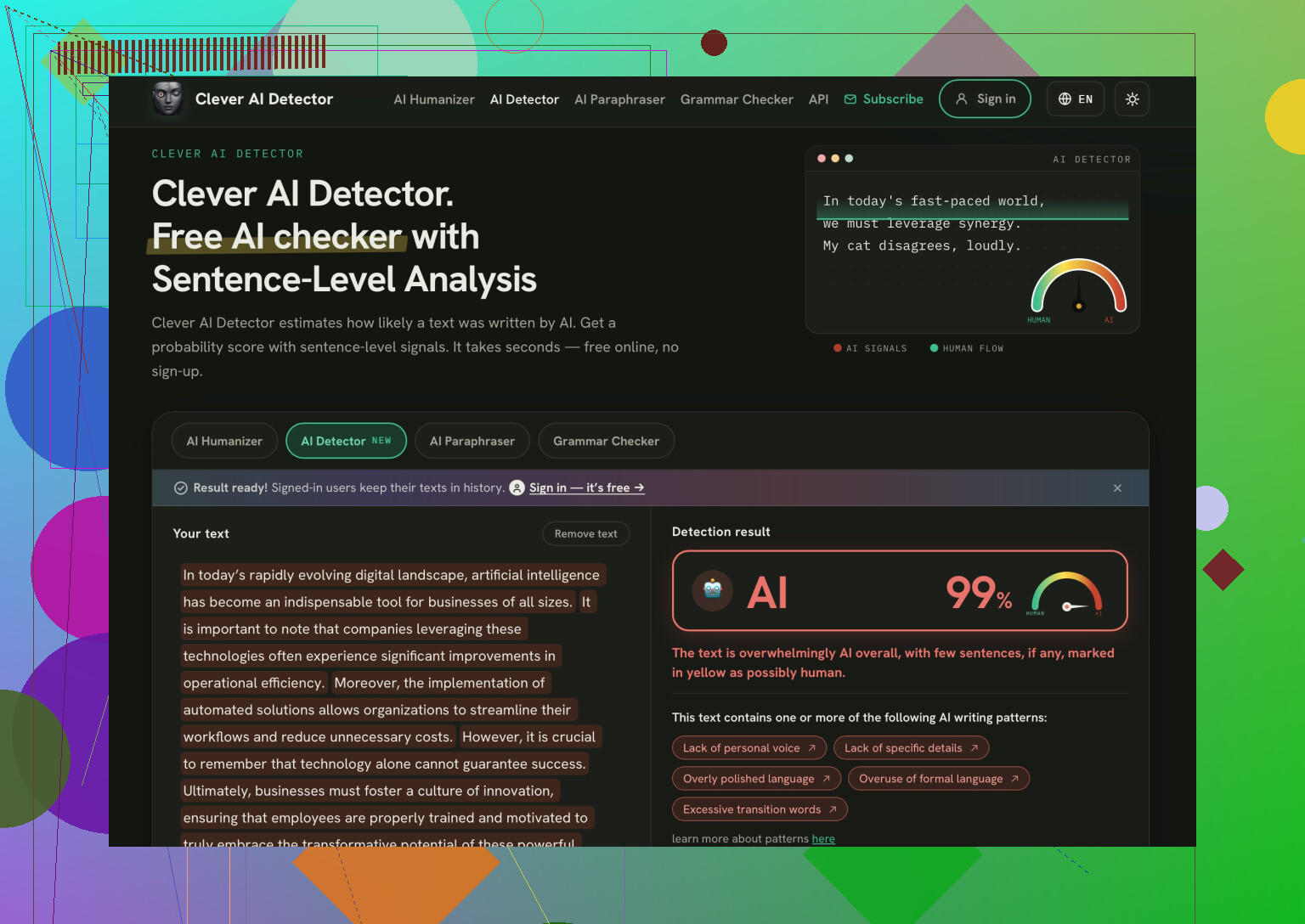
I can see why Clever AI Detector keeps coming up as the second opinion. For what it’s worth, the thing I like about it is that you can paste raw text straight in without making an account first, which matters when you just want a quick sanity read and not another login. Still a prompt to look harder, same as the rest. My actual rule would be narrower than most of the thread: if the claims check out and nothing in the submission violates a rule you can point to, publish it and stop poking at the number.