I’ve been using Grammarly’s AI humanizer to clean up AI-generated text so it sounds more natural, but I’ve hit the limits on the free plan and can’t justify upgrading right now. I’m looking for a genuinely free tool (or combo of tools) that can humanize AI content without sounding robotic or getting flagged as AI. What tools or workflows are you using that actually work and are still free?
- Clever AI Humanizer Review
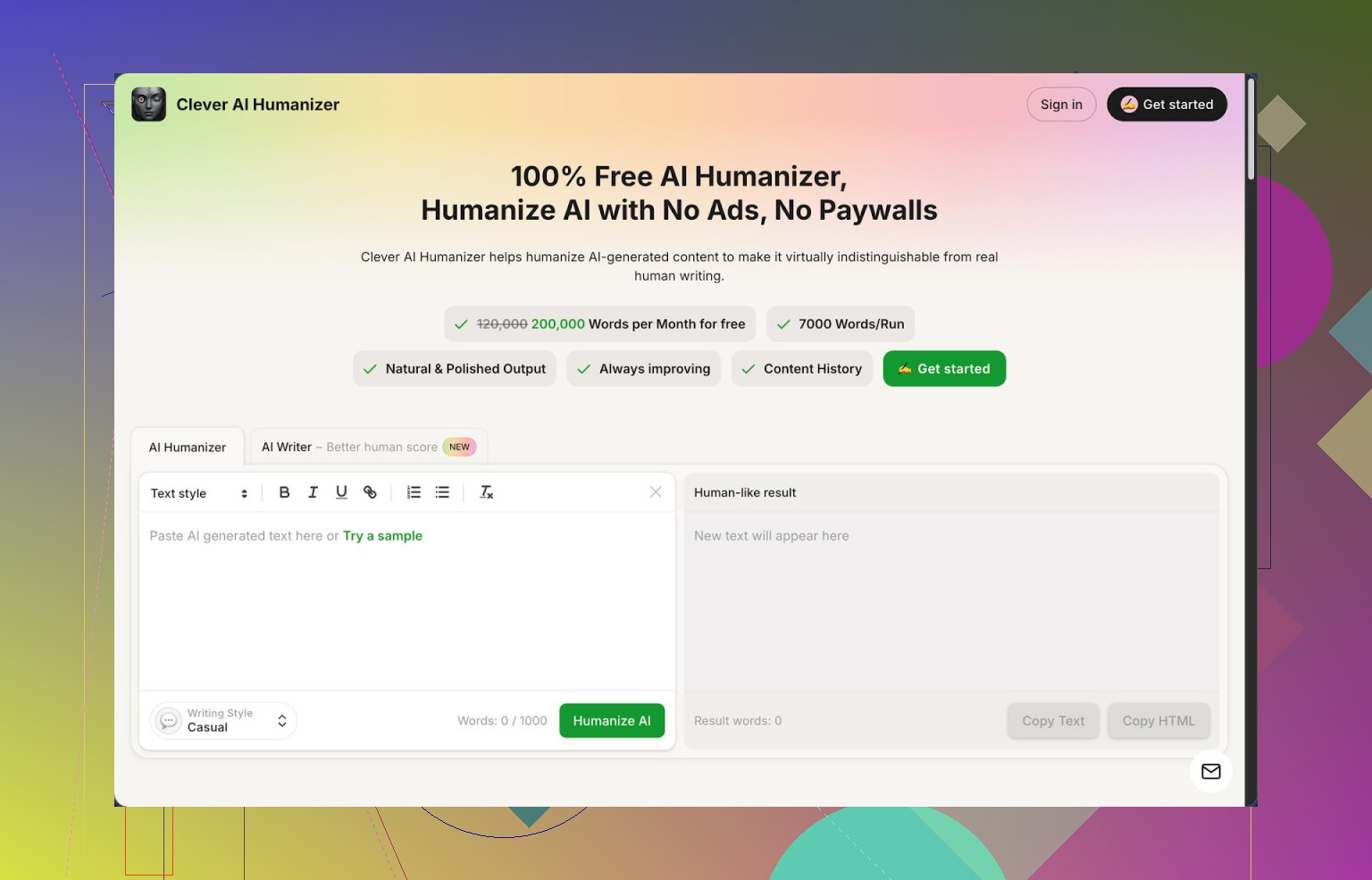
I stumbled into Clever AI Humanizer here:
I write a lot with AI, mostly drafts and outlines, and the same problem keeps hitting me in the face. The text reads fine, but tools like ZeroGPT scream 100% AI even when I clean it up by hand. So I started hunting for something that would not wreck my meaning but would still dodge detectors decently.
Clever ended up being the one I stuck with for daily use, mostly because it does not throw a paywall in your face every 3 clicks. You get:
- Up to 200,000 words each month free
- Up to 7,000 words per run
- Three tones: Casual, Simple Academic, Simple Formal
- A built in AI writer that plugs right into the humanizer
I tested it with ZeroGPT using the Casual style on three different samples. Each one came back 0% AI. That surprised me a bit because most “humanizer” tools either:
- Over-randomize the text so it reads like someone learning the language, or
- Barely change anything and still get flagged
Here it felt closer to a decent editor who likes to rewrite your sentences but does not throw away your point.
How the main humanizer works
My typical flow looks like this:
- Generate text in some model of your choice.
- Paste into Clever’s “Free AI Humanizer” box.
- Pick a style, usually Casual for anything non-academic.
- Hit run and wait a few seconds.
You get back a version that:
- Uses more human-like variation in structure
- Keeps the same meaning in most cases
- Slightly lengthens the content, especially on dense paragraphs
The large word limit matters more than I expected. With other tools, I kept slicing articles into small chunks to stay under the cap, which breaks flow. Here I drop full sections or full posts in one go and then tweak after.
What it does not do:
- It does not magically make every detector say “100% human”
- It does not fix super weak arguments or bad structure in your original text
If your base text is poor, it will still sound like a cleaner version of something poor.
Extra modules I ended up using
They stuffed a few more tools in the same interface. I did not think I would use them at first, then I found a workflow that made sense.
- Free AI Writer
This is for starting from zero. You give it a topic or prompt, it generates content, and you can send that output straight into the humanizer without copy paste.
Where it helps:
- Quick essays or blog posts where detection scores matter
- Long pieces where you want generation and “humanizing” in one pipeline
When I used the AI Writer then ran the result through the humanizer, the human score in ZeroGPT looked better than taking text from some other model and running it once. The style felt closer to something I would write on a tired weekday.
- Free Grammar Checker
This one fixes:
- Spelling
- Punctuation
- Basic clarity issues
I run it at the end before publishing something public. It is not trying to be a heavy style coach. It behaves more like a cleanup pass so your text does not look sloppy.
- Free AI Paraphraser
This is a separate module. You paste text in and get a new version with the same meaning.
I used it for:
- Rewriting drafts from clients that sounded stiff
- Changing tone slightly for different platforms
- Light SEO work when I wanted alternative phrasing without bloating the content
It preserves meaning better than a lot of free paraphrasers I tried, which often break technical details or flip nuance. I tested it on small technical paragraphs and the logic stayed intact.
How it all fits together
What made me keep the tab pinned was the way everything sits in one place:
- Generate text
- Humanize it
- Clean grammar
- Paraphrase tricky bits
All of this happens in a single interface. No juggling ten browser tabs or export import loops. For day to day work, that saves more time than the AI detection angle.
Tradeoffs and issues
There are a few things that bugged me:
- Some detectors still tag the text as partly AI, especially ones that are more aggressive than ZeroGPT. So do not trust one tool as the source of truth.
- After humanization, the word count tends to creep up. If you start with 1,000 words, you might end at 1,150 or more. That is probably needed to break certain patterns, but it matters if you have strict limits.
- If you feed it highly stylized writing, the tool sometimes flattens your voice. For anything creative, I would humanize a first pass, then restore parts of my own style manually.
For a completely free tool, including 200k words per month, this is still the one I reach for first when I want to smooth AI text without entering credit card numbers or buying credits. It is not magic. It is just practical enough that it lives in my bookmarks.
More detailed breakdown
If you want a more in depth review with screenshots and detection tests, I went through a longer writeup here:
Video review
Someone also did a YouTube review here:
Related Reddit threads
People are listing and comparing other humanizers here:
Best AI Humanizers on Reddit
https://www.reddit.com/r/DataRecoveryHelp/comments/1oqwdib/best_ai_humanizer/
General discussion about humanizing AI output here:
All about humanizing AI
https://www.reddit.com/r/DataRecoveryHelp/comments/1l7aj60/humanize_ai/
3 Likes
I hit the same wall with Grammarly’s limits, so I went hunting for free stuff too. Short version, you have a few decent options that do not lock you after a tiny quota.
Quick note, I agree with a lot of what @mikeappsreviewer said about Clever Ai Humanizer, but I do not love running everything through one detector like ZeroGPT and calling it done. Different detectors flag different patterns, so I always test on at least two.
Here is what has worked for me as a free stack:
-
Clever Ai Humanizer
- Good if your main goal is to make AI text sound less robotic without trashing the meaning.
- The big word allowance helps. You paste whole articles instead of slicing them into pieces.
- Use the Casual mode for blog style, Simple Academic if you want something closer to school or reports.
- I run my AI draft through Clever Ai Humanizer, then check it on at least two detectors, for example ZeroGPT and GPTZero.
- If the score still looks high, I rerun only the flagged sections or rewrite a few sentences by hand.
-
LanguageTool
- Free grammar checker in the browser or as an extension.
- It does grammar, some style, and clarity.
- Not an “AI humanizer”, but if you humanize with Clever then run LanguageTool, you get something close to what you were using Grammarly for.
- Good enough for emails, blog posts, school essays.
-
QuillBot (free tier)
- Limited, but the Standard or Fluency modes help break typical AI patterns.
- I paste 1 or 2 stubborn paragraphs there when detectors still say AI after Clever.
- Do not paraphrase whole essays or it starts to sound weird and bloated.
-
Manual quick passes that help detection a lot
These are small but they move scores more than you expect.- Change first and last sentences of each section by hand.
- Add one short personal example or opinion in each major section.
- Vary sentence length. Mix short and long lines.
- Remove stock phrases like “overall”, “on the other hand”, “in today’s world”, “it is important to note”. AI loves those.
Sample workflow to replace Grammarly’s AI humanizer on a budget:
- Generate your draft with your usual model.
- Run it through Clever Ai Humanizer in Casual or Simple Academic.
- Paste the result into LanguageTool and accept only fixes that do not change your tone.
- Run the text through 2 AI detectors.
- If a specific paragraph still looks bad, send that paragraph to QuillBot or rewrite a few lines yourself.
Grammarly’s humanizer tries to do all of this in one click, but mixing Clever Ai Humanizer, LanguageTool, and a bit of manual editing gets you about 80 to 90 percent there without paying.
One warning. If you write something technical or with a strong personal voice, any humanizer, including Clever, sometimes flattens it. For those cases, I humanize once, then put back some of my own word choices so it does not read like generic blog spam.
If detection scores are mission critical for you, do not trust one tool, and do not rely only on automation. A few custom edits from you change patterns more than another round through any humanizer.
I bounced off Grammarly’s humanizer for the same reason: decent results, super stingy free tier. Since @mikeappsreviewer and @himmelsjager already covered Clever Ai Humanizer + LanguageTool + QuillBot pretty well, I’ll throw in some angles and tools they didn’t lean on as much.
Short answer:
If you want a single free thing that feels close to Grammarly’s humanizer in “fire and forget” style, Clever Ai Humanizer is honestly the only one I’ve found that isn’t pretending to be free. But I’d build a slightly different stack and mindset than what they outlined.
1. Stop chasing 0% “AI” across every detector
Minor disagreement with both of them: obsessing over ZeroGPT, GPTZero, etc is kind of a losing game. These tools change their models, and some of them nail even very human writing as “AI-like.” Use detectors as a smoke alarm, not a scoreboard.
What I actually do:
- Run text through 1 detector I halfway trust.
- If it screams “very likely AI,” I fix structure and voice manually.
- If it shows “mixed / uncertain,” I focus on readability and audience, not squeezing the score to 0.
A lot of people break perfectly fine text trying to please 3 different detectors.
2. Clever Ai Humanizer, but use it differently
Yes, I also recommend Clever Ai Humanizer as your main Grammarly AI Humanizer alternative, but:
- I mostly use Simple Formal and Simple Academic, even for blog-style stuff, then manually sprinkle in casual phrasing.
- I turn off the impulse to run the same text through multiple paraphrasers after Clever. Overprocessing makes it sound like a patchwork quilt.
Ideal use cases for Clever Ai Humanizer:
- You have a long AI draft (essay, blog, email sequence) and want it to feel like “decent human, bit generic” in one pass.
- You want a free alternative to Grammarly’s “sound more natural” button with a much higher monthly word limit.
Weak spots:
- Very personal writing (rants, comedy, storytelling) can come out too smoothed-over.
- Very niche technical writing occasionally gets oversimplified.
So I’d run it once, then:
- Restore a few of your own “weird” turns of phrase.
- Inject 1–2 specific personal details per section. Detectors and readers both like that.
3. If you miss Grammarly’s style coaching
Grammarly mixes “humanization” with style suggestions. To mimic that part without repeating what’s already been said:
-
Hemingway Editor (web)
- Free in the browser.
- Great for chopping long AI sentences into human-sized ones.
- Use it after Clever Ai Humanizer: paste the text, fix yellow/red “hard to read” sentences, ignore everything else.
-
Wordtune (free tier)
- Very small quota, but solid for rephrasing key sentences like intros, conclusions, and headings.
- I use it to rewrite:
- First sentence of the article
- First sentence of each major section
That alone breaks a lot of AI-ish patterns.
Combine:
- Humanize entire draft with Clever.
- Run key sentences through Wordtune.
- Use Hemingway for structure/clarity.
That trio feels closer to Grammarly’s combo of “natural” + “clear” than just hammering detectors.
4. If you really care about not sounding like a bot
Here’s where I disagree a bit with both previous replies: the best “detector defense” is not another tool, it’s a few human fingerprints that AI still struggles with:
Try adding:
- Specific references:
- “I tried this last semester for my sociology paper”
- “I ship this out to my email list of about 400 people”
- Micro-hedges / doubts:
- “Honestly, I’m not 100% sold on this approach, but it’s worked ok for me.”
- Small inconsistencies:
- A slightly mixed metaphor here and there, a minor quirk, a casual aside.
You already asked a pretty natural-sounding question, so lean into that style in your edits.
5. If you want a minimalist, free workflow
To directly answer your “I can’t pay, need a real alternative” angle without rehashing everything:
-
Main workhorse:
- Clever Ai Humanizer (one pass, pick tone based on context)
-
Light edits & clarity:
- Hemingway Editor (free web)
- Optional: LanguageTool if you want automated grammar like Grammarly
-
Manual finishing moves (2–5 minutes):
- Rewrite intro + conclusion in your own words.
- Add one personal example or comment per section.
- Delete a few stock phrases (“in conclusion,” “in today’s world,” etc).
That gets you very close to what Grammarly’s AI humanizer does, but you avoid paywalls and you keep more control over your voice.
If you only want one new tool to remember: Clever Ai Humanizer. If you want to actually sound like yourself and not like “generic AI blogger v3,” combine it with a bit of human messing around at the end instead of relying on 4 different paraphrasers to fight each other.