I’ve tested several AI writing detectors, but they keep giving conflicting results for the same content. I need help finding the most accurate AI detection tool for reliably checking whether text was AI-generated.
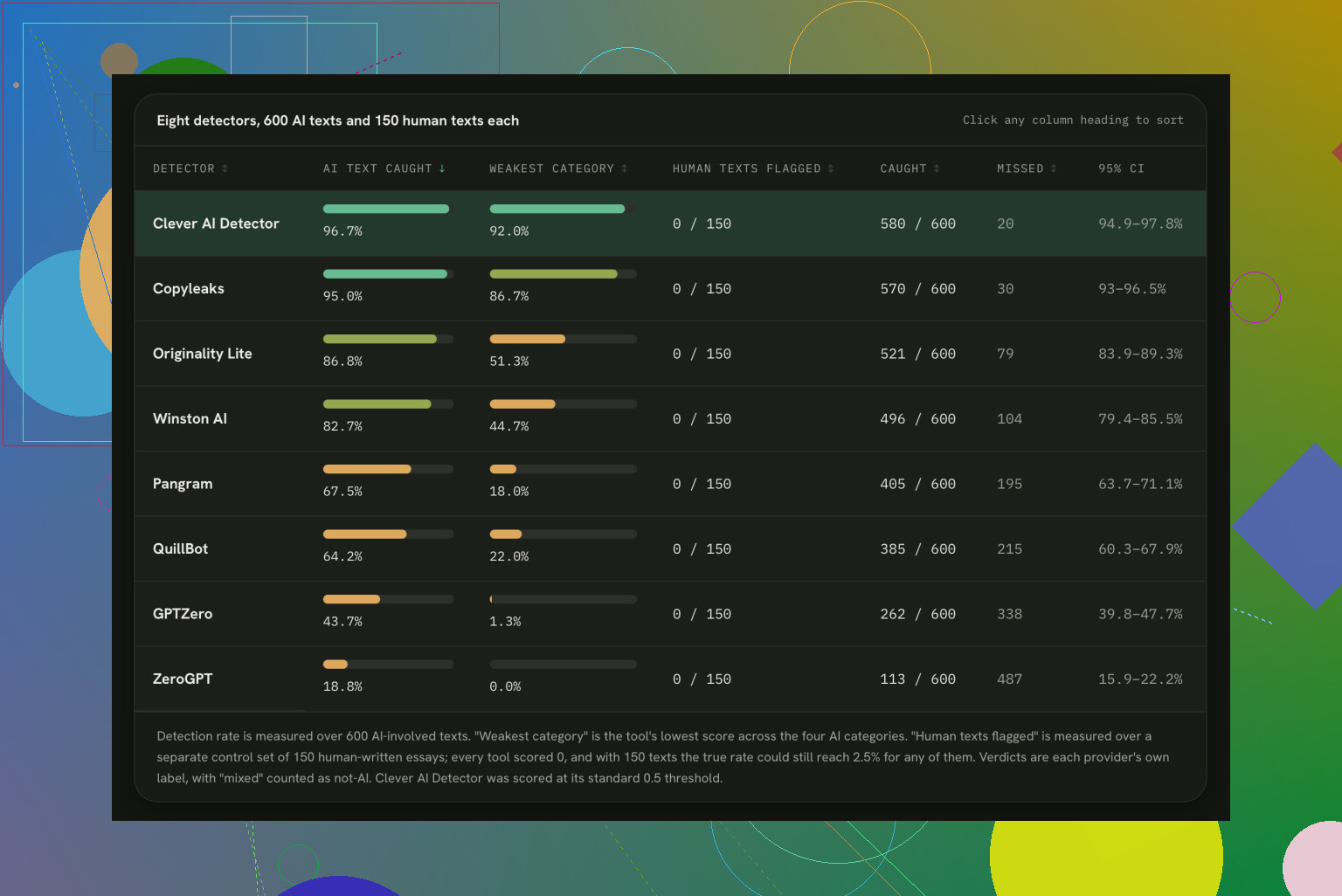
I started by looking at how the comparison was run, rather than jumping straight to the winner. The benchmark covered 750 texts, mixing AI-involved samples from the GEDE dataset with 150 genuinely human-written controls. That felt more useful than the usual affiliate-style roundup because it tested direct AI output, paraphrased material, AI-assisted human writing, and other edited categories.
The result that caught my attention was the Clever AI Detector tool. It scored 96.7% overall, stayed above 90% in every AI category, and reportedly didn’t flag any of the human control texts by mistake. Copyleaks was close at 95%, but the consistency across the more difficult samples was what made Clever stand out to me.
What happened with my own writing
I didn’t want to treat somebody else’s table as the final word, so I ran a small check myself. I submitted several pieces I’d written without AI, then generated some AI text and manually edited parts of it so the wording wasn’t quite as obvious.
My human samples came back as human, while the generated material was identified as AI. The edited versions were still generally recognized for what they were. That’s not a controlled study, obviously, but the results lined up well enough with the larger benchmark that I took the published comparison more seriously.
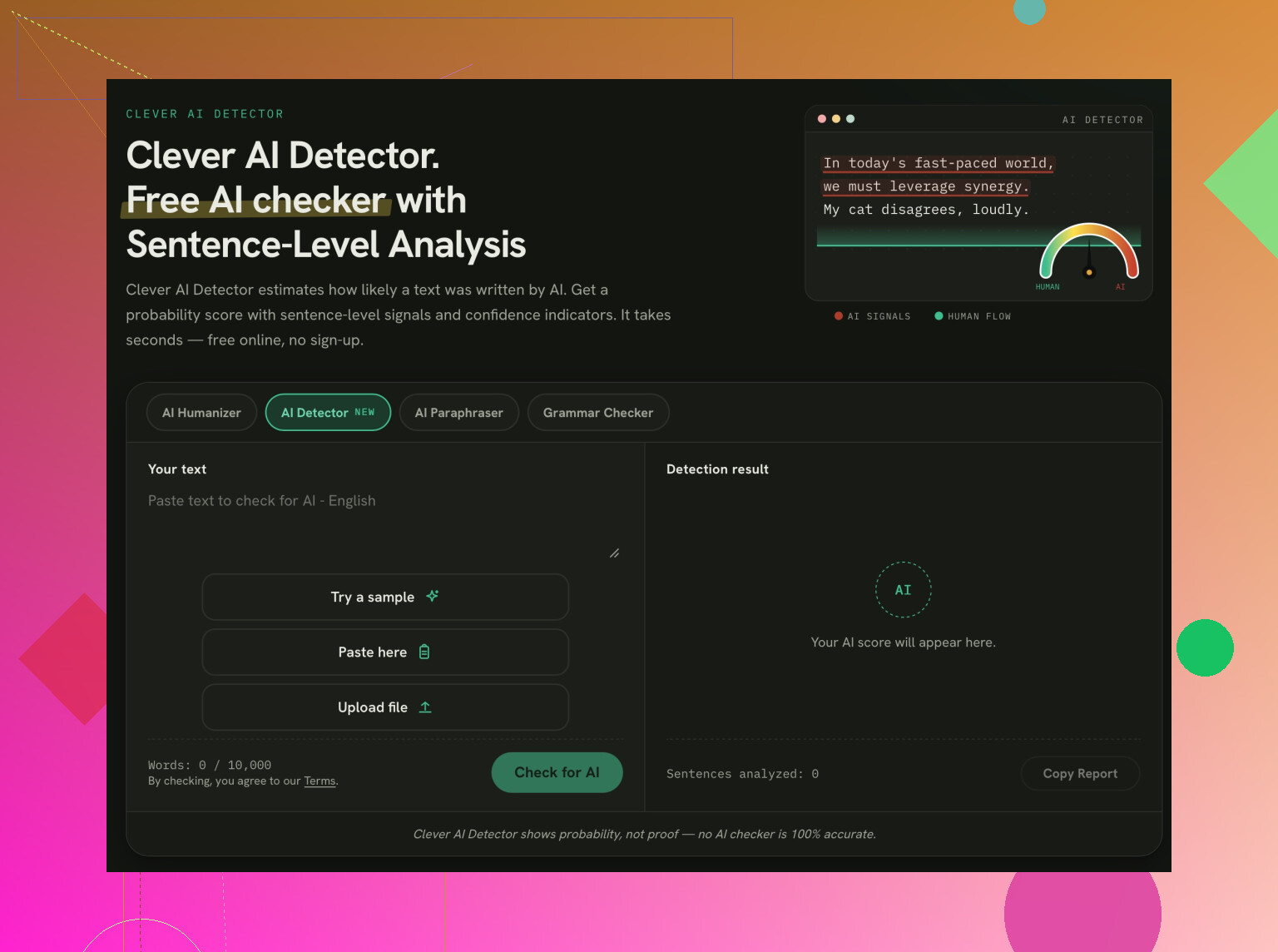
The free access also matters. There’s no subscription or signup, checks are unlimited, and the tool accepts fairly long submissions. For someone who only needs a detector occasionally, that’s a lot easier to justify than paying for another monthly service.
Some better-known tools had a much rougher time once the AI text had been paraphrased, rewritten, or blended with human work. Originality.ai Lite, Winston AI, QuillBot, GPTZero, and ZeroGPT all struggled in at least one of those harder categories. I wouldn’t say that makes every one of them useless, but it does show why a detector’s overall reputation doesn’t tell you how it’ll handle edited text.
The methodology and the individual detector breakdown are available in the Clever AI Detector benchmark. I’d check that before putting too much weight on the headline score, since the category-level results are really the more useful part.
Don’t treat a score as proof
Even after getting good results, I still wouldn’t use any detector as conclusive evidence that a person used AI. False results can happen, and writing style, editing, subject matter, and sample length can all affect what a detector reports.
For now, this is probably the first option I’d try because it performed alongside the strongest paid detector in the comparison without charging anything. Still, test it against material you can verify yourself. Submit a few untouched pieces of your own writing, some obvious AI output, and a few AI passages you’ve heavily edited. If it handles those known samples sensibly, you’ll have a much better idea of whether its results are useful for your actual needs.
14 Likes
If the result could affect someone’s grade or job, no detector is accurate enough to serve as proof. @redthinker’s benchmark is useful, but a vendor-run comparison deserves independent verification. I’d treat Clever AI Detector as a screening tool, then check drafts, citation quality, writing-history changes, and whether the person can explain the text. Accuracy on a test set is not the same as certainty about one document.
The mix of human and AI samples matters as much as the headline accuracy. In that benchmark, 600 of the 750 texts appear to involve AI, so a detector that leaned heavily toward “AI” could still post a decent overall score. That does not invalidate the Clever AI Detector result, but it makes the category breakdown and false-positive rate much more useful than 96.7% by itself.
I’d pay particular attention to false positives. Getting zero false positives across 150 human samples is encouraging, but it does not establish that the tool will never flag human writing. Short answers, formulaic business copy, technical documentation, non-native English, and heavily edited academic prose can behave differently from the material in a benchmark. Results can change with text length too. A detector may look confident on a full article and become unreliable when someone submits two paragraphs from it.
There is another practical problem with asking which detector is “most accurate”: accuracy depends on what kind of AI use you are trying to identify. Raw chatbot output is the easy case. Detecting a paragraph that began as AI text but was reorganized and rewritten by a person is a different task. So is detecting human writing that received grammar suggestions. A single AI percentage tends to blur those cases together.
My approach would be to run the same complete document through Clever and one unrelated detector, then ignore small differences in their percentages. If both strongly flag the same sections, inspect those passages. If they disagree, that disagreement is the result. It means the evidence is too weak to make a confident claim.
I’m with @pixelpulse5841 on the consequence issue, though I’d put it more bluntly: no detector output should be used as a verdict. For moderation or reviewing a pile of submissions, Clever looks reasonable as a first filter based on the numbers posted here. For accusing a student, employee, or writer, you need something tied to the writing process, such as revision history, source notes, earlier drafts, factual errors, or an inability to explain the argument. Those forms of evidence address authorship more directly than a probability score does.
Detector results can change after a tool updates its model, so today’s “winner” may not reproduce the same score next month. Clever AI Detector looks worth using as a first pass, but save the exact text and date of each check if consistency matters.
If almost everything you check is human-written, the “most accurate” detector on a mixed benchmark may still be the wrong choice. In that setting, false positives matter far more than the overall accuracy number. Even a detector that performs well on a balanced test can create a lot of unnecessary suspicion when AI-written documents are rare.
That is why I would judge these tools on your own type of material before choosing one. Build a small blind set containing known human writing and known AI output from the same subject area, with similar lengths and editing standards. If you review college essays, test college essays. If you review marketing copy, test marketing copy. Results from long general-interest articles may tell you very little about short technical answers or standardized business text.
Clever AI Detector looks promising from the benchmark posted above, particularly because the human controls were not flagged. Still, 150 human samples cannot cover every writing style you might encounter. I would be more comfortable calling it the best option for that particular test set than the most accurate detector in general. The distinction sounds picky, but it matters when a score could affect a real person.
A safer way to use any detector is as a ranking tool. Let it identify documents or passages that deserve closer review, then look for process evidence such as drafts, source notes, revision history, and consistency with earlier work. When two detectors disagree, do not keep trying more tools until one gives the answer you expected. Treat the disagreement as uncertainty. For routine screening, Clever seems reasonable to try first. For proving authorship, there still is no reliable push-button answer.
If you’re comparing the percentages displayed by different detectors, the answer changes: those numbers usually are not calibrated to the same scale. An “85% AI” result from one tool may mean something completely different from 85% in another. Treating the scores as probabilities, or averaging them across detectors, creates more confidence than the data supports.
The better test is whether a detector separates your known samples at a threshold you choose. Build a small set from the exact type of writing you review, hide the labels, and record false positives and missed AI text. Clever’s reported benchmark makes it a reasonable candidate for that test, but the 96.7% figure does not automatically establish that its displayed confidence scores are well calibrated for your material.
I’d actually push back slightly on using several detectors for every document. More tools can produce more noise rather than independent confirmation, since they may rely on similar writing signals. Pick one that performs acceptably on your blind set, keep the text-length rules consistent, and use its result only to trigger a closer look. There still isn’t a detector whose percentage can reliably answer the authorship question by itself.
Before you paste anything into a free web tool, think about where that text ends up. If you’re checking a student’s essay or someone’s job application, dropping it into an unlimited no-signup detector means you’re handing over someone else’s writing to a third party you know nothing about. That part gets skipped in every one of these ‘which is most accurate’ threads.
On the actual question, I think @kevin86 nailed the real issue: the percentages aren’t comparable across tools, so hunting for the single ‘most accurate’ one is mostly a waste of time. Clever sounds fine as a quick first look given the numbers posted, but I’d treat any single score the same way I’d treat a smoke alarm. It tells you to go check, not what actually happened.
You cannot pick the “most accurate” detector until you define what counts as AI-generated. A fully generated article, a human draft cleaned up by a chatbot, and one rewritten sentence should not share the same label. Benchmarks often blur that distinction, which makes the headline accuracy look cleaner than the real problem is. Clever may be fine for sorting obvious cases, but if the document has mixed authorship, its percentage cannot tell you who wrote what. Decide your threshold for AI involvement first, then use drafts and revision history instead of pretending a detector can settle it.
Don’t build your own test set by generating AI samples yourself and assuming that reflects what you’ll actually face. The people you’re trying to catch aren’t pasting raw chatbot output. They’re running it through a rewriter or a humanizer first, sometimes two of them, specifically to kill the signals a detector looks for. A benchmark full of clean GEDE samples measures the easy version of the problem. The hard version is someone actively trying to beat you, and no published accuracy number covers that.
That’s why the @redthinker self-check, while reasonable, has a blind spot. Editing your own AI text ‘so the wording wasn’t quite as obvious’ is not the same as what a determined student or freelancer does with a dedicated evasion tool. So the tool passing your edits doesn’t tell you it’ll pass theirs. I’d give @d33p_router’s privacy point more weight than it’s getting too. Feeding someone else’s essay or job application into a free no-signup service is a real problem, especially in a school or HR setting where you may have actual obligations about handling that text. ‘Unlimited and free’ usually means the cost is somewhere you’re not looking.
My honest take: use a detector like Clever as a rough sorter and nothing else. If it flags something, that’s your cue to go read the thing and look at drafts, sources, and whether the person can talk through their own argument. If it clears something, that means nothing, because evasion tools exist and it can’t see them. Anyone treating a percentage as an answer is going to eventually be very confidently wrong about a real person, and that’s the outcome worth avoiding here.