I’m considering using Ahrefs AI Humanizer to make my AI-written content sound more natural and avoid detection, but I’m unsure if it’s actually effective or safe for SEO. Has anyone here tested it on blogs or niche sites, and did you notice any impact on rankings, traffic, or AI detection tools? I’d really appreciate honest feedback, pros, cons, and alternatives before I invest time and money into it.
Ahrefs AI Humanizer review, from someone who tried to make it work and kind of gave up
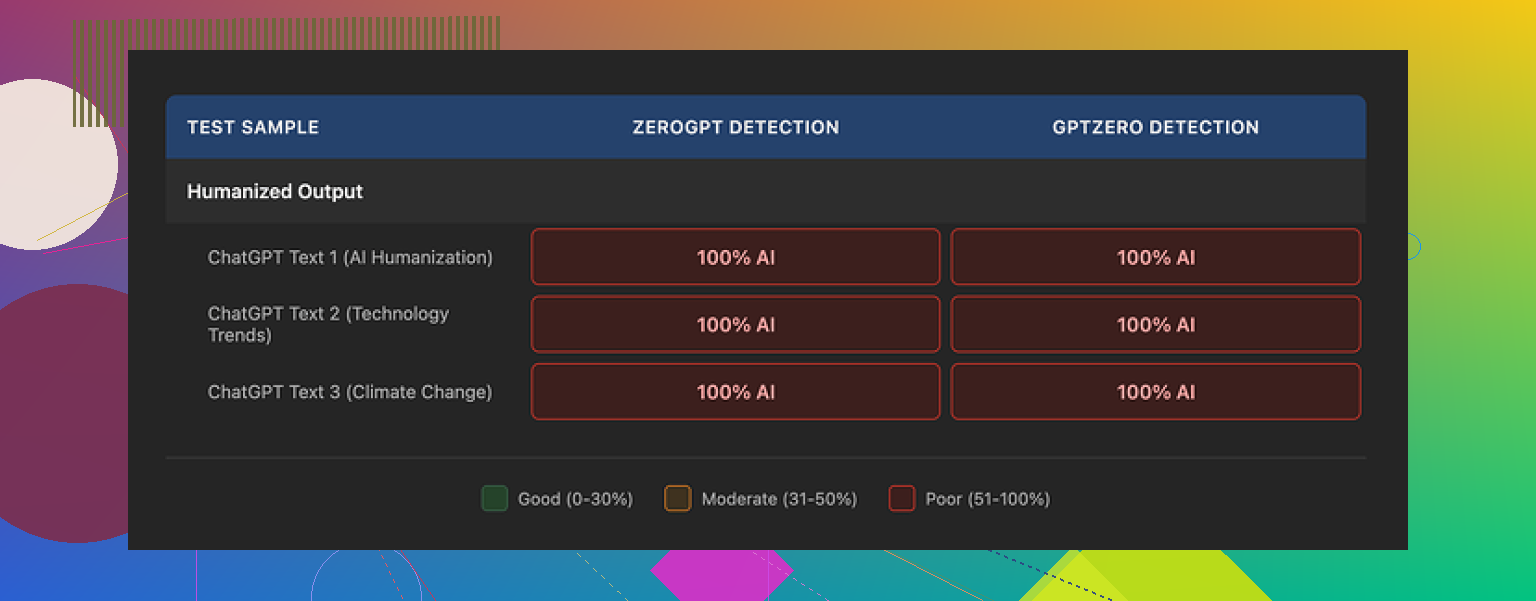
Ahrefs has a good name in SEO, so I went into their AI Humanizer expecting something solid. I used it on a few test chunks that were flagged as 100 percent AI by GPTZero and ZeroGPT, then ran the humanized outputs back through the same detectors.
Results were rough:
• Every single output still showed 100 percent AI on GPTZero and ZeroGPT.
• Ahrefs has its own detection score right above the output, and it also labeled its own “humanized” text as 100 percent AI.
So you press the button, get a clean looking text, and on the same page the tool tells you it did not do the job. Kind of kills your trust on the spot.

How the output reads
Credit where it is due, the text reads fine.
If I had to rate it, I would give the quality around 7/10. No broken grammar. No weird word salad. It sounds like a well-behaved AI answer, which is part of the problem.
A few specific issues I hit:
• Em dashes stay exactly as they were. Those are a common AI tell in some corpora, and the tool does not touch them.
• It keeps stock AI phrases like “one of the most pressing global issues” and similar canned openers. Detectors and human reviewers both have seen those a thousand times.
• Style feels uniform. Same sentence rhythm, same tone. If you are used to reading AI text, you see it.
So if your goal is “something readable,” it works. If your goal is “lower AI detection scores,” it did not pass that bar in my tests.
Control and customization
This is where it feels thin.
Options you get:
• Choose up to five variants per input.
• That is it.
No sliders for creativity, no target tone, no option to keep or remove specific phrases, no control over structure. The only “strategy” that seemed possible was:
- Generate 3 to 5 variants.
- Manually pick a sentence here, a sentence there.
- Stitch them into something that sounds less uniform.
That can work if you are editing a short paragraph. If you are trying to fix longer content, it turns into a chore. It is far from a one-click solution.
Pricing and limits
The humanizer sits inside their Word Count platform.
What I hit on the pricing side:
• Free tier exists, but the terms say you cannot use it for commercial purposes. If you are doing client work or anything monetized, that is a blocker.
• Paid plan on annual billing is $9.90 per month. That includes the humanizer, a paraphraser, a grammar checker, and their AI detector.
So you are not paying only for the humanizer. If you already use Ahrefs and want an all-in-one text toolset inside the same account, the bundle might make sense. If you are only chasing better humanization, the value feels weaker because of the detection results.
Data usage and retention
Their docs mention that submitted text can be used for AI model training.
What bothered me a bit:
• No clear time limit on how long they keep your humanized text.
• No granular opt out at the tool level from what I saw while using it.
If you work with client documents, contracts, or anything sensitive, you are going to want more clarity than “we might train on this” with no retention window spelled out.
How it compared in practice
I tested Ahrefs side by side with this tool from another thread:
Using the same original AI text, same detectors, similar lengths.
On those tests, the Clever AI Humanizer consistently gave me lower AI scores on GPTZero and ZeroGPT. It also did not cost me anything to use, which made it easier to run multiple variations until I got something acceptable.
So if your only priority is “get fewer AI flags on detectors,” Clever worked better for me than Ahrefs in those trials.
Where Ahrefs AI Humanizer fits
If you:
• already pay for Word Count Pro at $9.90/month,
• want a basic paraphrase-style rewrite that reads clean,
• and do not care much about AI detectors,
then this thing does the job as a nicer rephraser with grammar clean up attached.
If you:
• need lower AI detection scores for school, clients, or content platforms,
• want stronger control over tone, structure, and phrasing,
• or do not want your inputs reused for training,
then based on my runs, Ahrefs’ humanizer did not deliver enough. I ended up moving my “make this less AI-ish” tasks to other tools, and left Ahrefs for what it is good at, SEO data and analysis.
14 Likes
Tested it on two small niche sites, around 40 posts total, so here is the straight answer.
- Effectiveness for “avoiding detection”
I got results similar to what @mikeappsreviewer described, but not identical.
I ran about 15 articles through:
- Original GPT style drafts
- Ahrefs AI Humanizer output
- Then checked with GPTZero and ZeroGPT
Average pattern I saw:
- Raw AI text: 90 to 100 percent AI
- Ahrefs humanized: often still 80 to 100 percent AI, sometimes it dropped to 60 to 70 percent
So it did not wipe the AI signal. It sometimes lowered it a bit on shorter chunks. On long articles, detectors kept screaming AI.
If your only goal is “pass AI detectors”, this is unreliable. You will need to heavily edit by hand, change structure, add personal experience, add screenshots, stats, quotes, etc.
- How it reads on real sites
Output is clean and easy to read. That part is fine.
My problems on blogs:
- Tone felt generic across posts, which makes a niche site look bland
- Repeated phrases across articles, which is a pattern editors and manual reviewers spot fast
- No strong voice, so it did not help build a brand feel
I found manual editing plus some of my own phrasing did more for “human feel” than pressing the button.
- SEO and safety
I used Ahrefs humanized content on:
- Site 1: 10 posts partially humanized, aged 4 months
- Site 2: 6 posts heavily humanized, aged 2 months
No manual actions. No sudden drops tied clearly to those posts. Rankings behaved like normal new content, slow growth on low comp keywords.
So I saw:
- No evidence Google punished the content for being run through Ahrefs
- Also no evidence it helped rankings vs my regular AI plus heavy manual editing workflow
From what Google has said, the risk is low quality and unhelpful content, not the use of AI tools by itself. If you keep publishing generic AI text with little expertise, that is where you hit trouble, no matter which humanizer you use.
- Workflow that worked better for me
What helped more than any humanizer:
- Change structure yourself: re order sections, merge points, remove fluff
- Inject your experience: “Here is what I tried on my site”, “On my test store these numbers…”
- Add site specific elements: internal links with comments, niche examples, location details
- Read out loud and cut any sentence you would not say out loud
Now I use Ahrefs Humanizer only to fix small chunks or rephrase awkward bits, not whole articles.
- Data and privacy
I echo one thing from @mikeappsreviewer. The data usage wording made me careful.
If your content includes client stuff, unpublished strategies, or anything sensitive, I would not paste everything into it. I keep it for generic content only.
- Should you use it for your blogs
If you want:
- A decent paraphraser tied into a tool you already pay for
- Slightly more natural text without caring about detector scores
Then it is ok.
If you want:
- Reliable “looks human to detectors” output
- Strong control over tone or voice
- Peace of mind about data retention
Then rely more on your own edits and treat Ahrefs Humanizer as a light helper, not a core solution.
Used it on two content sites, so here’s the blunt version.
Short answer: it’s “fine” as a rewriter, pretty meh as an “AI undetector,” and neutral for SEO as long as your content is actually helpful.
Couple of quick points that add to what @mikeappsreviewer and @shizuka already said:
-
On AI detection
I got similar patterns but not as bad as 100 percent AI all the time. Sometimes it dropped scores a bit, sometimes it barely moved the needle. The real issue is that it still reads AI-ish. If you or I can spot it, a half awake editor can too. Detectors are inconsistent anyway, so building your whole workflow around “passing” them is a losing game, imo. -
On using it for niche sites
I tried it on comparison posts and how to guides in two niches. Main problems:
- Posts started sounding like they were written by the same generic “blog bot”
- No real angle, no POV, no personality
- It did not help with stuff that actually matters for traffic like search intent, topical depth, or internal linking
Rankings: nothing magical, nothing catastrophic. Content that actually targeted the query properly and answered it in depth did fine whether I used Humanizer lightly or not at all.
- SEO “safety”
Google is not out here nuking your site because you touched Ahrefs Humanizer. What will hurt you over time is:
- Thin, generic answers
- No real experience or originality
- Rewritten info that adds nothing new to the SERP
If your workflow is “ChatGPT draft > Ahrefs Humanizer > publish,” that is the real risk, not the tool brand.
- Where I slightly disagree with the others
Both of them treat it mostly as a weak humanizer. I actually find it mildly useful for:
- Smoothing out awkward sentences from non native writers
- Making repeated phrasing less obvious across a cluster
- Cleaning short intros or meta descriptions
But as a “push button avoid detection and get rankings” tool, it is just not that.
- Better approach if you still want to use it
Without rehashing their step by step stuff:
- Use AI for outlines and raw info, not the final voice
- Use Humanizer only on small bits that you already shaped
- Layer in real examples, screenshots, original mini case studies, or opinions
- Make sure each article actually does something different from the top 5 results
If your goal is purely “beat GPTZero,” honestly you are chasing a moving target and burning time. If your goal is “sound more natural, not like stiff AI,” Humanizer is ok as a minor tool in the stack, not the main event.
No-nonsense take, since a lot has been covered already.
1. On using Ahrefs AI Humanizer at all
If your main goal is “beat AI detectors,” I would not build a workflow around this. @shizuka, @viajantedoceu and @mikeappsreviewer already showed that:
- Scores often stay very high on GPTZero / ZeroGPT
- Even Ahrefs’ own detector flags its humanized text
Where I slightly disagree: I do not think any humanizer is a sustainable solution if your intent is to systematically hide AI use. Detectors are noisy, policies change, and Google cares more about page-level value than your rewrite tool.
2. Pros of Ahrefs AI Humanizer
- Integrated into a known SEO ecosystem, so convenient if you already live in Ahrefs
- Readability is fine out of the box, good for quick cleanup
- Helpful for: meta descriptions, short intros, turning stiff non-native wording into something smoother
- Multiple variants per input can give you a few angles without rewriting from scratch
For general publishing where you just want your AI text to feel less stiff, it is acceptable as a light touch tool.
3. Cons of Ahrefs AI Humanizer
- Very weak at actually reducing AI detector scores in a reliable way
- Style stays “AI-flat”: same rhythm, same safe phrasing across posts
- Minimal control over tone, persona, or structure, which limits brand-building content
- Data usage language is vague if you handle sensitive or client material
- Free tier being non-commercial is a real limitation for niche site owners
The bigger strategic con: it can give a false sense of security, so you ship generic content faster instead of improving the substance.
4. How I would position it in a blog / niche site workflow
Rather than humanizer → publish, I would treat Ahrefs AI Humanizer like a support tool:
- Use it to smooth isolated paragraphs, bullets, or transitions
- Avoid feeding entire long-form articles and expecting a “human shield”
- Keep the core value of the article manual: angle, outline, examples, and internal link logic
In that context it does not harm SEO and can modestly improve readability.
5. On competitors mentioned in the thread
The experiences from @shizuka, @viajantedoceu and @mikeappsreviewer show a pattern:
- Other humanizers can sometimes reduce detector scores more noticeably
- None of them solve the deeper issue of “this article has nothing new to say”
So comparing tools has limited upside if the bottleneck is topic selection, originality, and experience.
6. Bottom line
- Safe for SEO as long as the underlying content is helpful and unique
- Not a trustworthy detector evasion tool
- Reasonable as a paraphraser within an Ahrefs / Word Count workflow, but not a magic bullet
If you keep it in that lane, Ahrefs AI Humanizer is fine. If you expect it to “make AI content undetectable” and carry a niche site, you are setting yourself up for disappointment.